View our Main Site »

Monday, June 25, 2012

Tasting with multiple bodies

When it comes to tasting craft beer, context is king.

By Weston Easton, Professor-in-Training

In this short tale, I’d like to explore the way one thinker has changed the way I experience taste on an everyday basis. In a yet-unpublished book chapter, Annamarie Mol writes about taste as being a lynchpin between the physical world of nature and the intangible world of human society. She roots this suggestion in the physical act of tasting, which, she argues, is a bodily act as much as it is a human social and psychological experience. Moreover, Mol uses this act of tasting to make an argument about the body: the idea that the body is multiple. 

Here’s how this works. The argument is actually quite simple. Yes, our bodies are whole things. But if we trace the way we taste (keeping in mind the definition above) from one situation to the next, this changes. The body becomes multiple as it too varies situation to situation. Her example is that we mobilize taste differently in different contexts. She gives the cases of tasting for poison, as undertaken by tasters screening the dishes of ancient emperors, of tasting to acquire specialized knowledge about food and drink, or tasting to eat less food, or to eat enough. So then our bodies, as represented here by taste, change in different contexts and situations.

I think this idea is interesting and useful for people who think deeply about the food they eat and the beer they drink. Or better yet, for recognizing that people who do think deeply about things such as craft beer probably do not always taste in the same way in every context. Let me give an example. Think about some of your favorite beers. Do they always taste the same? My bet is that you, like, me, experience variability from beer to beer, even if its the same brand or label. When the taste is different, do you ever wonder whether this is do to a chemical difference as much as a difference in place, company, or mood? These questions deal with expectations.

Another set of questions might get at intentions. Do we always drink or eat for the same reasons? I think this is especially important for craft beer drinkers. Our kind are known for seeking out new tastes and getting excited about new horizons. But we’re also known for being painstakingly nuanced and distinguishing tasters. When we are tasting a craft beer, we are deliberate in our intentions: we evaluate the beer based on a certain set of standards or criteria. The point here is to recognize that in craft beer culture, taste has been mobilized as a highly specified (think style), codified (IBU’s), and standardized (see BJCP.org) practice, the aim of which is to objectify taste—an act Mol shows to be a highly subjective and contextual thing. At the same time, taste (in beer) has also been transformed into a symbol of who we are as people, what our food values and ethics are.

Why point this out? For one, I think its important to recognize that the way we interact with craft beer is a specific thing. We do not mobilize taste the same with craft beer as we do, say, with water. We use personal discretion, but this discretion is not entirely of our own devising. Moreover, in different contexts, we taste differently. As others have recently pointed out, even craft brewers themselves do not always drink craft beer. PBR, for instance, is popular with West Michigan brewers as a “good corn beer.”

A brewer is an especially good example of the way taste operates differently in different contexts and of how the body is multiple. Brewers' professional identities depend on creating distinguishable tastes consistently, yet they themselves drink outside of their own brand’s portfolio. Tasting sweet wort, a brewer uses all her skills to adjudicate and determine if the specimen meets established standards. Yet out in the tap room, he/she may drink a pint for either “quality control” or for simple relaxation. These shifts are bodily shifts. Using the example of a latte or other coffee drink, Mol points out that treats like these provide our bodies “a break from working” where instead of trying to “master the world” we can “just live” and “be appreciative.” The latter could certainly involve corn beer.

So, for me at least, thinking about Mol’s point—that we mobilize taste differently in different contexts, and that our bodies are therefore multiple and contextually located—has led to a new personal mantra: be aware of the different ways I mobilize taste. I like to think of this as a first step. A successive step is to reflect back on how the way I (consciously or unconsciously) mobilize taste steers my preferences and intentions and therefore my body/mind’s experience of taste. Said differently, we get what we’re looking for with taste, and are therefore capable of fooling ourselves even before we do any actually tasting.

Friday, June 22, 2012

New Beer Friday - June 22 Edition

Snapseed By Chris Siciliano

It's officially summer. Siciliano's recommends you celebrate the fact appropriately by following these simple steps. (1) Peruse the selection of new beers located on the list below. (2) Mark, check, highlight, or otherwise indicate the beer(s) from the list that you most want to try. Feel free to mark all of them. (3) Tell your boss you have a dentist appointment. (4) Stop by Siciliano's to purchase beer in the necessary quantities. (5) Play hooky for the rest of the afternoon. (6) Repeat steps 1-5 every Friday until September.

New (and Returning) Beer

  • MacTarnahan's Spine Tingler Golden Belgian-Style Triple, $5.79/22oz - "A surprisingly sublime Belgian-style triple offering an electrifying blend of spicy aromatics balanced with a lively malt palate that is so good it's scary" (source).
  • Victory Summer Love, $1.79/12oz - "With the sublime, earthy familiarity of noble, American and German hops backed up by fresh and clean German malts, Summer Love Ale® ends with a surprising burst of lemony refreshment from fistfuls of American whole flower hops. Love Summer, now" (source).
  • Sprecher Black Bavarian Lager, $2.59/16oz - "This intensely dark Kulmbacher style lager has a superb malt complexity with the distinctive flavors and aromas of coffee, caramel and chocolate. A renowned smoothness and a creamy, tan head make it an all-time brewery favorite" (source).
  • Sprecher Hefe Weiss, $2.29/16oz - "This coarse filtered wheat ale is fermented with a German yeast culture for a refreshingly light spiciness and hints of citrus fruit. A cloudy appearance and an immense creamy head are characteristic of this lightly hopped Bavarian brew" (source).
  • New Holland Golden Cap Saison, $1.79/12oz - "Golden Cap Saison is a modern interpretation of a traditional farmhouse ale. A soft, pale beer, Golden Cap embodies the flavors and aromas of summer fields. Brewed with an ancestor of wheat called spelt, its straw-colored body, lively carbonation and a unique fermentation profile evoke fresh cut hay and cracked peppercorn" (source).
  • Round Barn Summer Wheat, $1.79/12oz - "An unpretentious American pale wheat beer, our Summer Wheat pours a cloudy golden-orange, just like a sunset over Lake Michigan. Its assertive wheat flavor is complimented with hints of citrus zest. Garnish with a slice of orange or lemon" (source).
  • Echt Kriekenbier, $4.19/11.2oz - "This refreshing ale is based on Vichtenaar and has the aroma of Kirsch cherry brandy, smooth, vanilla-like oaky palate and late surge of passion-fruit flavors with some acidity. Local sour cherries are added during the maturation process to the wooden casks containing Vichtenaar. The final product is a blend of 1, 2 and 3 years old beers" (source).
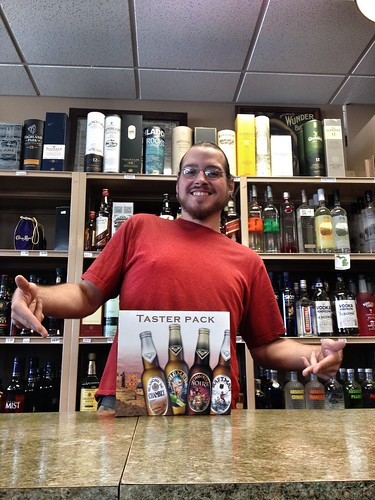
  • Unibroue Taster Pack, $11.29/(4)12oz bottles - "Taste our Legends"
      • Blanche De Chambly - "Subtle bouquet of spice, citrus notes, aromas of yeast breads, coriander, and cloves" (source).
      • Ephemere - "Delicate balance of fruit and spice, hint of sweetness, hint of tartness, redolent of Granny Smith Apples" (source).
      • Chambly Noire - "Smooth roasted grains, mildly smoky notes , and spices (cloves, green anis, mint) with a chocolaty finish" (source).
      • Raftman - "Smoked malt whisky, low acidity masked by a caramelized apple flavor with a taste of fine yeast" (source).
Photo of the Week

IMG_3160
Impromptu tasting at Pike 51 Brewing Co.
By the way, they now have about this many beers on tap,
give or take.

Wednesday, June 20, 2012

Deal of the Week - Don Manuel Villafañe Keltehue Malbec

IMG_3148
By Chris Siciliano

Good things come in small packages—that old saying is never more accurate than when the package is a bottle and the good thing is wine.

Sicilliano's featured deal this week is a half or "split" bottle of a delicious Malbec from the Mendoza region of Argentina. It's called Don Manuel Villafañe Keltehue Malbec 2009 ($4.49/375ml) and while clearly not the best choice for dinner parties, the smallish size makes perfect sense for picnics or your favorite outdoor summer concert series (providing the park rules permit alcohol, that is).

What's the one drawback of a half-sized bottle? This wine is so tasty it'll be gone before you know it. That's why we recommend buying two. Or three. Or, well, you get the idea. At $4.49 per bottle, you can afford to buy in bulk. Here's the full description from the label.
Our talented ancestor Don Manuel de Villafañe began making wine in Argentina in the year 1611. It is in his honor that we have created a superb line of wines representing the finest varietal grapes of Maipú, Mendoza. We think he would be very proud.
Malbec is the backbone of the Argentine wine industry for a good reason, it is fantastic. The grape that came from Cahors near Bordeaux has found its perfect home in Argentina, and more specifically in Mendoza. This is an absolutely superb example of how good this wine can be at an affordable level. The wine's dense red color gives a full and rich fruit nose of wild berries and black currant. The mouth is lush and full leading to a very well-balanced and long finish...the true mark of a great Malbec.
This is the red that can be enjoyed with everything or nothing. Any meat dish will love to be paired with this wine. Also has a great acidity for tomato based pasta dishes. Truly a fit-all read.
Limited quantities. Get yours today!

Tuesday, June 19, 2012

The Beer that Began it All: Edition Steve

Welcome back to "The Beer that Began It All," the new Buzz video series in which industry professionals recount specific life-changing moments that led them down the road to craft beer enthusiasm or, in some cases, obsession.

Today's installment features Steve Siciliano, owner of Siciliano's Market, senior contributing writer for The Buzz, signer of paychecks and, for that reason, a pretty decent fella.

Friday, June 15, 2012

New Beer Friday - June 15 Edition

IMG_3106By Chris Siciliano

Sunday is Father's Day. With the exception of Christmas, New Year's Eve, and maybe World Sauntering Day, there is no other holiday where it makes as much sense to shop at Siciliano's.

We are, in effect, the go-to place for all your father-pleasing products. Cigars? Sure. Beer? You bet. Homebrew equipment? Yes, and ingredients, too. Not to mention winemaking stuff and books on the subject and Scotch if you must or cider if that's more to your dad's liking. The list goes on and just so know, it also includes gift certificates.

There is, in fact, absolutely nothing else in the world your old man would rather have than a gift that you, wonderful son or daughter, picked up at Siciliano's Market. It's a proven, indisputable fact, verified repeatedly using the most rigorous scientific methods.*

Okay, now that the obligatory marketing speil is over, all of us at Siciliano's would like to say this—Happy Father's Day to all the dads out there. Your guidance, wisdom, and so forth is much appreciated. (I'm talking to you, Pop.)

*No actual science was used in the writing of this or any other New Beer Friday.

New (and Returning) Beer

  • New Holland White Hatter, $4.79/22oz - "An innovative hybrid of styles landing between white ale and India Pale Ale. White Hatter brings spice, hops, and fermentation notes together flavorfully. Pairings: seafood, fennel, mushrooms" (source).
  • New Holland Black Hatter IPA, $4.79/22oz - "A blackened version of Mad Hatter brewed with black malt for a dark, roasty sweetness to the base of the flavor profile. Finishes with a strong centennial hop character from dry hopping" (source).
  • New Holland Rye hatter, $4.79/22oz - "This beer showcases it’s grain-bill, made up of rye and barley malt. The rye adds a slight spiciness to the caramel-malt base, while also creating a creamy texture. Dry-hopping contributes a fresh citrus finish" (source).
  • New Hollland Oak-Aged Hatter, $4.79/22oz - "Mad Hatter IPA aged in Kentucky Barrels. Round, smooth wood character brings a new dimension to dry-hopped, aromatic hoppiness" (source).
  • New Holland Farmhouse Hatter, $4.79/22oz - "Farmhouse Ales were originally brewed as 'Provision Beers' by farmers in Belgium and France, brewed in the winter months to be consumed during hot summer work days. They were traditionally brewed light and refreshing to aid in both hydration and energy. Wheat and Pilsner malts were used to lighten up the body of this Mad Hatter version. It was also fermented hot with a strain of Belgian Saison yeast to develop flavors of green apple, pepper and fresh cut hay" (source).
  • New Holland Four Witches Black Saison, $2.39/12oz - "The Four Witches art, illustrated by Kyle Bice, develops on Golden Cap’s theme, with a nod to Wizard of Oz, as L. Frank Baum wrote the book while summering in Holland, MI. White and dark roasted wheat provide deceptively delicious body, and a playful reference to Oz’s contrast between good and wicked witches. Caramel rye and barley continue the story, along with a unique yeast character and mild spicing" (source).
  • Blue Point Summer Ale, $1.69/12oz - "The delicious golden taste of Summer Ale comes from a substantial portion of wheat malt added to a traditional barley malt mix which gives this delicious brew a unique tartness not found in many beers today. No surprise – this light, thirst-quenching brew is best enjoyed on hot Summer days" (source).
  • Lagunitas Under Cover Investigation Shut Down Ale, $1.89/12oz - "Our oxymoronic 'Imperial Mild' - A redux to remember the '05 St. Paddy's Day Massacre. Defiant as to style...we can say for sure it is unforgiven and unrepentant" (source).
  • Paulaner Hefe-Weizen, $1.89/12oz - One of your favorite German hefes now available in cans.
  • Dundee Summer Wheat Beer, $1.19/12oz - "An American-style wheat beer. Brewed with 40% wheat and a touch of rye malt to produce a refreshingly unique flavor. Aroma hops, fruity esters and a thick, creamy head top off this summer classic" (source).
Picture of the Week

IMG_3112
This Father's Day, treat your old man to a cigar from Siciliano's.

Cheers!

Wednesday, June 13, 2012

Michigan Micro Caps - It's a game about beer

By Chris Siciliano

On the Buzz recently I wrote about a new Michigan craft beer-themed smartphone game being developed by Fusionary Media, the good folks who built the Siciliano's website. We're pleased to announce that the game—Michigan Micro Caps—is now available on the Apple app store. Go here to check it out!

Just a reminder, this free-to-download game also functions as a portable index, cataloguing Michigan breweries and providing users with links to websites, maps, and social media pages. In this sense, the app is a very useful (and did I mention free) tool that will most certainly come in handy on your next extended Michigan-centric road trip.

And who knows, with 101 breweries included, you might just discover one or two you never knew existed. I know I did. Red Jacket in Calumet, Jasper Ridge in Ishperning, Founders in Grand Rapids—tell me you've heard of these before.

Apologies Android users, Michigan Micro Caps is currently available for the iPhone/iPad only. Michigan MicroCaps now available for Android!

Tuesday, June 12, 2012

Tuesday Review: New Zealand Sauvignon Blanc

IMG_3070
The boss with two good NZ Sauv Blancs
By Steve Siciliano

I don’t always drink white wine, but when I do, I prefer a New Zealand Sauvignon Blanc.

With apologies to the most interesting man in the world, I couldn’t think of a better line to describe how I feel about the Sauvignon Blancs coming out of New Zealand. I enjoy good Chardonnays, I like bone dry Rieslings, and sometimes I’ll opt for a bottle of Vignoles or Pinot Grigio, but right now no other white wine blows my hair back like an NZ Sauv Blanc.

Like many other vinifera varietals, the Sauvignon Blanc grape originated in France where it is grown primarily in the regions of Bordeaux and the Loire Valley. Solid wines are also being made from the grape in California, Chile and Australia. But it's the opinion of some wine experts that New Zealand is producing the finest Sauvignon Blancs in the world.

With individual grape varieties it’s always about how the fruit is affected by a particular region’s specific soil composition and distinctive micro-climate. One region that produces Cabernet Sauvignons of incredible depth and balance will produce Pinot Noirs that are thin and acidic. New Zeeland’s gravelly soil and maritime climate combine to produce Sauvignon Blancs that are perfectly balanced with layers of bright tropical fruit and racy acidity.

Arona and 3 Brooms are two excellent Sauvignon Blancs from New Zealand’s Marlborough region that we currently carry at Siciliano’s. Priced at $11.49 and $14.49 respectively, they are excellent values and are perfect accompaniments to grilled fish and chicken, or are wonderful for just sipping on those hot summers’ nights on the deck.