View our Main Site »
Showing posts with label philosophical musings. Show all posts

Thursday, May 9, 2013

Let's Lay Claim to the Title of Beer City USA

By Steve Siciliano

Like every Grand Rapidian who is passionate about craft beer,  I am hoping that our town retains the coveted designation of Beer City USA. I’m not going to present a litany of reasons as to why Grand Rapids is more deserving of this honor than the other cities in Charlie Papazian’s poll. Plenty of folks have already done that, sometimes with extreme jingoism and prejudice, in the comments section on the online polling website. While I certainly believe that our city deserves the Beer City USA designation, at the same time I have to admit that there are other cities around the country that are equally worthy of this moniker. Since this is the case, I see no reason why we have to wait to see if the title is once again bestowed on us—we should just simply claim it.

What I’m suggesting has precedents. Detroiters call their city Hockytown despite the fact that each of the other six original NHL cities can also lay claim to that moniker. Tampa is known as Cigar City even though Miami probably produces just as many stogies. There are many cities around the world that are known as “the city of churches.” The lesson is this—if we want our city to be known as Beer City USA we just need to begin calling it Beer City USA.

I believe that all we need to accomplish this is a coordinated marketing campaign. If a few of our more visible businesses and institutions begin changing their names there will be a trickle down effect. I think Beer City Arena has a nice ring to it, as does the Beer City Grand Hotel, Beer City State University and Beer City International Airport. It wouldn’t take long before we would be seeing Beer City Pizza, Beer City Tool and Die, the Beer City Café, etc. Maybe the last three options are more viable.

Let the other cities around the country slug it out each year for the arbitrary title. Grand Rapids will be the real Beer City USA, in part, because we say it is, and mostly, well, because we know it is.

Help render the bossman's argument unnecessary. Vote now for Grand Rapids as Beer City USA for 2013.

Monday, April 22, 2013

Monday Musings: Homebrewers Are a Hardy Bunch

The question is, what will
 this look like 10 days from now?
By Steve Siciliano

Yesterday I watched a pair of mallards happily paddling around on a pond in my backyard that wasn’t there just a week ago. In downtown Grand Rapids over the past few days the river has gotten dangerously close to the top of the flood walls, Riverside Park is now under water and swollen creeks in Kent County have washed roads and two-lane bridges away. We’ve certainly had a lot of rain lately.

I usually don’t take Michigan’s roller coaster weather personally. Normally I stoically cope with the breath-sapping humidity of summer, the grey gloom of late November and early December and the unrelenting, bone-chilling temperatures of winter. But I have been taking the incessant rain this spring personally because, you see, the Big Brew on the Calder is now less than two weeks away.

But so what if these ceaseless April monsoons continue into May? We west Michigan homebrewers are a hardy bunch. If it’s still raining two weeks from now we’ll don the appropriate gear and fire up the burners. We won’t let a little inclement weather deter us from gathering May 4 on the Calder Plaza to be part of the largest AHA Big Brew Day in history. And at one p.m. EST on that day, whether it’s raining or shining, we will join in a simultaneous, country-wide toast to the enriching hobby of homebrewing.

Wednesday, April 10, 2013

Recollections in Wine: A Short Course in Chianti

2007 San Leonino Castellina
Chianti Classico, $14.39/750ml
By Steve Siciliano

Sometimes I can’t remember where I put my car keys, but when it comes to a few select experiences from my distant past involving wine, I have wonderful recall. After thirty years I can still remember exactly where I was when I first tasted a Napa Valley Cabernet Sauvignon. It’s been ten years since Barb and I had a wonderful dinner at Hattie’s Restaurant in Suttons Bay (now closed), yet I distinctly recollect the flavors and aromas of the velvety smooth Beaulieu Vineyards pinot noir that we drank with grilled pork chops smothered in a cherry barbecue sauce.

I can also vividly recall my first experience with Chianti. It was in the mid 1970s in a quaint Italian restaurant in the Bronx. Pictures of the Coliseum, the Leaning Tower of Pisa and Michelangelo’s David were on the walls, Dean Martin was crooning on a cassette player and there were red and white checkered tablecloths. In the middle of our table sat an empty, straw-covered wine bottle holding a candle. I asked the old, broken-English-speaking waiter to bring out a full one. While the restaurant’s veal parmesan was magnificent, the wine that came in that whicker basket bottle was atrocious.

Twenty years later in an Italian restaurant on Rush Street in Chicago, another old waiter persuaded me to give Chianti another try. I remember being surprised that the bottle he brought to the table wasn’t one of those whicker fiascos. The gnocchi in that restaurant rivaled my grandmother’s, and that bottle of Ruffino Chianti Classico Reserva Ducale, with its flavors of dried orange, earth and dark chocolate, was so good that I ordered another.

For a wine to be legally called Chianti it must be produced in one of seven demarcated regions in Tuscany and consist of a blend that strictly adheres to Italian wine laws. The blend was once comprised solely of grapes indigenous to the Tuscan region—sangiovese and canailo for the reds, malvasi and/or trebianno for the whites. As Chianti became more popular after World War II, vineyards were planted in areas that produced inferior fruit and winemakers began using the maximum percentage allowed of the less expensive white grapes in the blend. As a result, the quality of Chianti gradually declined. By the late 1960s, it had become thin, unbalanced and acidic, and was probably purchased more for the quaint fiasco than for the wine inside.

Faced with tarnished reputations and declining sales, Tuscan winemakers began taking steps in the mid 1970s to improve the quality of Chianti—less white wine was used in the blend and inferior vineyards were torn up. A few of the more innovative makers even began experimenting with non-indigenous varietals such as cabernet sauvignon, merlot and cabernet franc with impressive results. But since these new wines didn’t follow the traditional Chianti formula, they couldn’t legally be called Chianti. Wine writers nicknamed them the Super Tuscans, a moniker that is still used today. Prompted by the international success of the Super Tuscans, the Italian government revised the traditional formula and winemakers are now allowed to use non-indigenous grapes to produce Chianti.

Today Chianti has reclaimed its position as one of Italy’s most important wines. While it will probably always be associated with quaint Italian restaurants and traditional Italian cuisine, thankfully those once ubiquitous, straw-covered bottles, and the inferior wine they contained, no longer are producing unpleasant memories.

To start making your own memories with Chianti, try San Leonino Castellina Chianti Classico, pictured above and currently available at Siciliano's Market.

Thursday, December 20, 2012

Beware the "Local" Trap

By Wes Eaton

The buzzword “local” has grown in popularity in recent years. But more than this, notions of “being local” have accompanied an increasing number of projects and enterprises, and this is certainly true for West Michigan. But has “local” lost its bite? Is “local” at risk of being co-opted? If so, where do we draw the line, and who ought to draw it?

For me at least, notions of “local” are symbolically charged with concepts like authenticity, originality, limited availability, craftsmanship, integrity, and honesty. In other words, local products and local practices carry with them the normative assumption that they are better than such goods and services that are not local. What this seems to imply is that local goods are worthy of our trust. We have built up the notion of local to quite a high standard, and if this is indeed the case, my argument is that we need to listen to those who would caution against “the local trap.”

In 2006, two planners, Brandon Born and Mark Purcell, published a provocative paper titled Avoiding the Local Trap: Scale and Food Systems in Planning Research that made some points I’d like to share with my fellow West Michiganers. Before I go on, I want to point out that their agenda is not aligned with global corporations—entities we assume are threatened by our turn toward local economies. Rather, the authors are concerned that all the fanfare about being local has obscured many of the socially positive things “local” is actually taken to mean. In other words, the definition, use, and value of the concept of local is itself at the center of conflicting ideas of social betterment, and those who see local in the way I romanticized above had better take a closer look at how this powerful and meaningful concept is being put into play.

Like good planners, Born and Purcell unpack the notion of locality by pointing out that what this essentially implies is “scale.” They are anxious to point out the ways that scale, in this case, local versus global, has been misconstrued with socially positive concepts such as justice, sustainability, and democratization. In making this conceptual and emotive slip, we fall into the “local trap,” a pitfall that can blind us “to the most effective strategy for achieving desired ends.”

Thinking about this requires us to ask a couple key historical questions. How did we turn toward the local in the first place? And what were we turning from? Globalized food systems have been increasingly decried in the media and well as in everyday culture. If global food system players, such as, say, Anheuser-Busch InBev are the problem, then locally produced beer is the solution. Indeed this has been a rallying cry in our community for years now, especially from folks like me. But the “local trap” points out that there are limitations with this simplistic, black and white way of understanding the world, and understanding food systems in particular.

The point Born and Purcell stress is that we need to distinguish between issues of scale and issues of socially desirable practices and outcomes, whatever they may be in particular contexts. In other words, scale can creep in and supplant these other “desired ends.” Take beer for example: what are our collective “desired ends” for craft beer? Their paper has three specific things to say about distinguishing between “scale” and “desired ends.” First, scales (such as “local food”) are socially constructed, meaning they are contingent on political struggles. Second, scales are never stagnant, but are always in flux. They are a project that people work to achieve, but are continuously contested by other interests. Finally, scales are relational, meaning they only make sense in relation to other scales. Rather than taking scales such as “local” or “global” at face value, they argue, we ought to interrogate how the relationships between scales are fixed and unfixed by people pursuing specific political, social, economic, and ecological goals. We should ask why a particular scale is better than others for achieving specific goals, “and these goals should be distinguished from the scale used to pursue these ends.”

What can we learn from and how can we use these insights? While our answers are likely contingent on our own personal or professional interests, the first advice I might offer is that the ends we are all looking to pursue need to be made more clear, and following Born and Purcell, distinguished from “scale.” We need to ask, is “being local” an end in itself, or is it a means to an end? While Born and Purcell might argue the latter, I would think that others would agree with my pointing out that this does not tell the whole story. In some cases being local is clearly concomitant with socially, ecologically, and economically positive ends. Take the case of restaurants and chefs who seek out locally grown and produced food and beer so as to reduce pollution from transportation, resist the concentration of capital in the hands of the few, and support an up and coming generation of small farmers. This story and others like it certainly resonates in West Michigan. But does local automatically mean these things? Many of you, I’m sure, can think of examples where the notion of “local” has been exploited by people both powerful and less so, instances where the product and service fell far short of the promise that came—and we knowingly or unwittingly attributed—with the glowing badge of “being local.” After all, all places are in effect “local” if we are near them. In this sense then, local is a pretty low standard. My argument, then, is this: we take a lot of pride and have a lot at stake in our local goods and services. Beyond “scale,” let’s emphasize exactly why what we have to contribute is authentic, integral, unique, and substantially important for our economies, communities, and cultures.

Monday, October 29, 2012

A Good Night on Grand Rapids’ West Side

IMG_3455

This piece was written the morning after Game Two of the 2012 Word Series. Despite the Tigers' difficult loss in that game (and in the Series in general), former Siciliano's staffer Wes Eaton managed to find the beauty in a West Side Thursday night.

By Weston Eaton

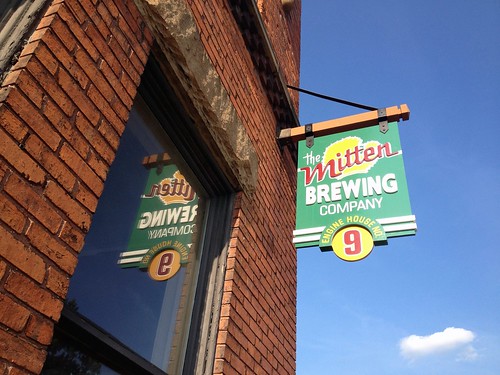
While there are many that can speak with more authority on the matter, I’m certainly not a slouch when it comes to Grand Rapids’ West Side. Between small bowling allies, butcher shops, Latino grocers, Monarch’s Club, and Siciliano’s Market, I cross the river on at least a weekly basis. Max Trierweiler and Chris Andrus now bring us all one more reason to do so: the Mitten Brewing Company. As I’m sure many of you have heard, the idea is to bring together craft beer and baseball in an explicit way – hence the name “mitten”.

With the Tigers in World Series crises mode, my wife and I headed to the new “sports” bar, snuck in the back door to avoid the half block long IPO (initial public opening) line out front, and made our way to the bar in much the same way one struggles to front stage at the Orbit Room. While the room was packed and lines long, this is to be expected on an opening night. Or is it? With restaurants and craft breweries popping up like Morels in Spring across West Michigan, you might think that new craft beer venues like Perrin, White Flame, Harmony, or the Mitten (to name just a few) would need to slowly, steadily cultivate a dedicated following, and that this would take time. Indeed in the long run this may be the case, but from my recent experiences in the taproom at Perrin and last night at the Mitten, I got the feeling the beer was going to stay fresh.

Speaking of beer, my wife wrestled us a Porter and Hefeweizen from the throngs. Both were excellent, the Hefe closer to a Dunkel Weizen, the color of hazelnuts, and the Porter black with a tiny tan head and a heavy roast, which is how I like it. Not exactly sure who brewed these beers, but its likely the Mitten’s new co-brewer Robert Wanhatalo (aka Wob), formerly of the Hideout, played an important part. In the future, look for experimentation in line with the trails blazed by Joe Short.

While drinking our inaugural beers, we looked over the beer and baseball fans, finding more than one Beer City USA t-shirts on display. Like other badges, this symbol has come to embody a new collective identity within the area’s beer community, a signifier of not only past and present successes, but also a suggestion for future agendas. I felt this momentum, this change, strongly when walking past the the old firehouse that is the new brewery. I knew where I was – the city’s West Side, across from the seasonal Latino ice cream stand, the old Juke’s bar, and Quarry Ave, where I lived for years and my wife grew up – but now these familiar places seemed much more a part of the past, and the street lined with beer (and Tigers) fans was something new. I am not lamenting change now, and this is not what I experienced last night. Instead, I felt a little ‘Brooklyn’ in the air, meaning to say a buzz of activity and possibility that excites and inspires.

But this is of course only one way to understand the city’s West Side, on the cusp or not. In fact, telling the story in this way downplays culinary and beer culture happenings that have been going on in the areas for some time now. Moreover, I’ve clearly defined “the cusp” by my own biased set of standards – through the lens of craft beer. There are of course other ways to value the West Side, in terms of beer culture. Take for instance the Holiday Bar, a special treat a stone’s throw away from Salvatore’s Italian Restaurant (which serves the best lasagna in town).

Stepping out from the Mitten’s IPO energy, we were still thirsty and the game was still on – and the Holiday was waiting. Were were greeted with numerous seats at the expansive, curved, lounge style bar, and the enthusiastic Jim, Grand Rapids’ most ubiquitous bartender. Yes there are craft beers on tap – some of the city’s finest – but the circumstances, meaning a need for some perspective, called for tasty cheap red wine and a cold High Life. Developing an appreciation for this range, from the new to the old, is what the coming West Side experience is all about.

Wednesday, July 11, 2012

Now Playing at the Drive-In: Nostalgia

By Doug Dorda

The sun sinks below the clouds, a myriad of pinks and purples adorn the horizon. The air is filled with the gentle murmur of nearby folk, and the soothing whir of idling engines. Anticipation runs high, as all eyes turn toward a screen seemingly hovering above the ground. Lights dim and an illuminating omnipresent glow stretches across the screen—a woman's voice can be heard from car stereos and ancient speakers mounted on cables. She says, “Welcome to the drive-in!”


Welcome to the Getty Theater
I will never forget my first experience at a drive-in movie theater. My brother and I lay in the back of my parents van with the doors swung wide open. My parents sat dutifully in lawn chairs to the sides of the vehicle. From our view, it seemed as though the entire landscape teemed with the magic of cinema and the remnants of a dying art. Imagine my dismay years later when I learned of that theater's closing; it was with heavy heart that I reminisced about the wonderful times I had enjoyed with my friends and family. “Lost to the isle of memory,” I told myself.

As each summer passed in kind, there lingered the memory of a magic I wouldn't be able to feel again. I longed for the ability to stock a cooler with beverages, snacks, and all other provisions that one could hope for whilst in the hearty companionship of friends and family. It seemed as though I was doomed to seeing films in theaters with pricey concessions, long ticket lines, and wailing children for the rest of my movie-going life.

Then, a week or so ago, a dear friend approached me about seeing a double-feature at a nearby theater. Wonderful, I thought, at least I can still see two films for the price of one (for those unfamiliar with a drive-in, most commonly you will see two films instead of one). “But,” I asked, “Where in town shows a double-feature these days?”

“At the drive in, dude!” he yelled as though I were a moron for not having made the connection.

With a grin on my face, I hugged my friend as hard as I've ever hugged anyone that has delivered me good news. A bit bewildered, I began to ask the inevitable questions of where the theater was, and how much a ticket cost. Though there is no drive-in within Grand Rapids' city limits, just a short drive to Muskegon there awaits the Getty Theater, a great mecca of nostalgia, beckoning to passersby with a vintage sign that simply invites you to become a child again, if only for one night.

My friends and I made the journey, cooler and chairs in tow. We stuck our claim (set up camp if you prefer) and tucked in for what was to prove a wonderful way to spend an evening. As I surveyed the crowds at each separate screen, I allowed my eyes to go out of focus. In the fading twilight it was easy to imagine every car as a Cadillac, and every patron as either a greaser or “soc." It was simply magnificent to have found that magic again.

However wonderful I may have felt, it was also easy to hear the chatter of some of the folks near us.

“It's a shame, honey,” said a woman near me. “This may be the last year for the drive-in, so let's try to enjoy this!”

A little boy and his mother were headed to the children's movie a few screens over. I allowed a frown to unfold on my face for just a moment before I realized that I was that child at one time. My mother had said those words to me the very first time I had gone to the drive-in near my home town. I was graced with seven additional years enjoyment from that theater, and those memories alone had gotten me to go and find a new one with friends. Perhaps we can help save this passtime after all, I thought. Are not homebrewers, purveyors of craft, and DIY-ers steeped within the culture of the way things used to be? Are we not the type of people who diligently seek tradition, and long for things to be, in one way or another, as they once were. Do drive in theaters fit the bill of something we should strive to keep alive? It is the opinion of this writer, that they are. Sure, it may be out of the way, and it may seem a little ridiculous a thing to fret over. Yet I put it to you, when was the last time you witnessed the stars and a near full moon over a movie theater screen? For me, it was two short weeks ago.

The Getty theater is located just a short distance from 96 in Muskegon. For tickets and showtimes go here.

Monday, June 25, 2012

Tasting with multiple bodies

When it comes to tasting craft beer, context is king.

By Weston Easton, Professor-in-Training

In this short tale, I’d like to explore the way one thinker has changed the way I experience taste on an everyday basis. In a yet-unpublished book chapter, Annamarie Mol writes about taste as being a lynchpin between the physical world of nature and the intangible world of human society. She roots this suggestion in the physical act of tasting, which, she argues, is a bodily act as much as it is a human social and psychological experience. Moreover, Mol uses this act of tasting to make an argument about the body: the idea that the body is multiple. 

Here’s how this works. The argument is actually quite simple. Yes, our bodies are whole things. But if we trace the way we taste (keeping in mind the definition above) from one situation to the next, this changes. The body becomes multiple as it too varies situation to situation. Her example is that we mobilize taste differently in different contexts. She gives the cases of tasting for poison, as undertaken by tasters screening the dishes of ancient emperors, of tasting to acquire specialized knowledge about food and drink, or tasting to eat less food, or to eat enough. So then our bodies, as represented here by taste, change in different contexts and situations.

I think this idea is interesting and useful for people who think deeply about the food they eat and the beer they drink. Or better yet, for recognizing that people who do think deeply about things such as craft beer probably do not always taste in the same way in every context. Let me give an example. Think about some of your favorite beers. Do they always taste the same? My bet is that you, like, me, experience variability from beer to beer, even if its the same brand or label. When the taste is different, do you ever wonder whether this is do to a chemical difference as much as a difference in place, company, or mood? These questions deal with expectations.

Another set of questions might get at intentions. Do we always drink or eat for the same reasons? I think this is especially important for craft beer drinkers. Our kind are known for seeking out new tastes and getting excited about new horizons. But we’re also known for being painstakingly nuanced and distinguishing tasters. When we are tasting a craft beer, we are deliberate in our intentions: we evaluate the beer based on a certain set of standards or criteria. The point here is to recognize that in craft beer culture, taste has been mobilized as a highly specified (think style), codified (IBU’s), and standardized (see BJCP.org) practice, the aim of which is to objectify taste—an act Mol shows to be a highly subjective and contextual thing. At the same time, taste (in beer) has also been transformed into a symbol of who we are as people, what our food values and ethics are.

Why point this out? For one, I think its important to recognize that the way we interact with craft beer is a specific thing. We do not mobilize taste the same with craft beer as we do, say, with water. We use personal discretion, but this discretion is not entirely of our own devising. Moreover, in different contexts, we taste differently. As others have recently pointed out, even craft brewers themselves do not always drink craft beer. PBR, for instance, is popular with West Michigan brewers as a “good corn beer.”

A brewer is an especially good example of the way taste operates differently in different contexts and of how the body is multiple. Brewers' professional identities depend on creating distinguishable tastes consistently, yet they themselves drink outside of their own brand’s portfolio. Tasting sweet wort, a brewer uses all her skills to adjudicate and determine if the specimen meets established standards. Yet out in the tap room, he/she may drink a pint for either “quality control” or for simple relaxation. These shifts are bodily shifts. Using the example of a latte or other coffee drink, Mol points out that treats like these provide our bodies “a break from working” where instead of trying to “master the world” we can “just live” and “be appreciative.” The latter could certainly involve corn beer.

So, for me at least, thinking about Mol’s point—that we mobilize taste differently in different contexts, and that our bodies are therefore multiple and contextually located—has led to a new personal mantra: be aware of the different ways I mobilize taste. I like to think of this as a first step. A successive step is to reflect back on how the way I (consciously or unconsciously) mobilize taste steers my preferences and intentions and therefore my body/mind’s experience of taste. Said differently, we get what we’re looking for with taste, and are therefore capable of fooling ourselves even before we do any actually tasting.

Monday, June 11, 2012

Everyday masterpieces: the art above us

The sky over Lake Michigan,
Sleeping Bear Dunes
By Steve Siciliano

Sometimes when I look at the sky I imagine that I’m gazing at a painting. It could be a painting of a clear summer morning when the horizon is brightening and a white ghost of a moon is fading into the gradually deepening blue. I study how tree-top greens look against the expanse of blue and if I’m lucky a few high flying crows will add distant specks of ebony to the canvas.

Other times it might be a picture of billowing, snow-white clouds floating silently like icebergs in a crystal blue ocean. Sometimes the artist will choose to use the darker colors of the palette—slate, ash and charcoal grays, boiling dark purples and roiling burnt umbers. If it’s a painting of the sky at twilight there could be pastel layers of crimsons and pinks, reds and yellows, magentas and oranges.

Above us each day are works of art that rival museum masterpieces. An upward gaze is the only price of admission.

Wednesday, June 6, 2012

Collaboration and symbiosis in the craft beer world

When it comes to selling, serving, or brewing craft beer, no one business can afford to be an island unto itself (a peninsula maybe).

By Steve Siciliano

The other day when Barb and I were at Founders one of the bartenders mentioned that he recently sent some folks our way who were looking for some Michigan beers. I thanked him and said that we in turn direct many out-of-towners to the brew pub.

I love having this type of rapport with Founders, Hop Cat and other local brew pubs and craft beer bars. We are always referring folks to these establishments and they constantly send customers to our store. Sharing the common denominator of craft beer, our businesses have formed mutually beneficial associations that I like calling symbiotic relationships.

Two ancient Greek words meaning “living” and “together” combine to form the word symbiosis. It is a term that was initially used by anthropologists to describe how people in a community have to cooperate to live together. The word has, however, been appropriated by biologists and today is most often used to describe the mutually beneficial relationships that exist between separate biological species. Because I feel that it’s an apt way to describe the cooperative attitude that exists within the craft beer industry as a whole, I’m appropriating it back.

There is a refreshing non-competitiveness amongst folks in the craft beer community. Unlike mega breweries that spend millions on advertising trying to snatch a bigger piece of the market, the vast majority of craft brewers seem more interested in spending their dollars on producing quality beer. And unlike the big boys, craft brewers are eager to share ideas, knowledge and resources. I highly doubt, for an example, that we’ll ever see a collaboration brew from MillerCoors and Anheuser Busch.

Doubtless this spirit of cooperation exists because craft brewers realize that the strength of the individual enhances the strength of the whole and that synergy rather than cut throat competitiveness is the key to the continued success of the craft beer community. I feel fortunate indeed to be part of a community that realizes that symbiotic relationships can be mutually beneficial and more productive than Machiavellian business tactics.

Monday, May 21, 2012

A mown commodity

The lawn-mower shed
Household chores afford us the opportunity to see value in the simple things.

By Steve Siciliano

When I opened the shed door our dog Ellie Mae shot past me and began hunting. I share the space in that old shed with the chipmunks and squirrels. I stow my shovels, rakes and mower on the floor and they hoard their walnuts above the sagging wallboard ceiling. Barb and I talk about replacing the shed and we probably should. It’s hardly worth putting more paint on the dry-rotted boards and there are a few spots where the moss-covered shingles aren’t keeping the rain out. But I kind of like the way the old shed looks, and I really don’t mind sharing it with the critters.

After backing the lawn tractor out I lit a cigar. I like to take my time mowing the lawn. Always rushing through life can wear you down and as I grow older I’m finding that being in a state of non-hurriedness is the best way to approach things. I could certainly mow the lawn faster. I could zip around the yard intent only on getting the job done. I could careen around the one-acre lot keeping one eye on the job at hand and the other on what needs to be done later. But it’s impossible to just be when you’re not living in the present. And when you’re always focused on the future you tend not to notice things.

That day while cutting along the stand of trees on the edge of the back yard I noticed the explosion of pink and white flowers on the wild blackberry bushes. I thought about past Julys when I plucked ripe berries from my slow moving perch. To the left where there’s a stand of bamboo I observed how much taller the new shoots had grown in only a week.

When I navigated around and through the line of spruces I recalled how small they were when we planted them. While moving through the wide open expanse of the backyard I was happy for the startled moths that fluttered up from the ground and felt bad about the ones that didn’t. I noticed the robins landing in the mower’s mulched wake and wondered what they were pecking at. (Feasting, perhaps, on those unfortunate moths?) When negotiating around the weeping cherry trees I thought about how their wrinkled trunks look like an elephant’s. I saw the swift moving shadow of a wide-winged bird and looking up spied a low sweeping hawk. While avoiding the protruding roots of the ancient silver maples on the side of the house I wondered how much longer they would be shading us. In the front yard I braked to allow a slow-hopping toad make it to the shelter of the hostas.

After putting the mower back in the shed I went in the house and looked through the window at the fresh mown lawn. “Sure takes you a long time to cut the grass,” Barb said looking up from her book.

“Yes,” I replied. “It sure does.”

Wednesday, April 25, 2012

Life is a carnival (believe it or not)

A ferris wheel to some.
To others, an object of terror.
The title of today's post is a tribute to the great Levon Helm, who passed away last week; it's also a fitting lead-in to the boss' latest Buzz contribution. A lost set of car keys, paying several times market value for some cheap stuffed animals, it's all part of a good night at the carnival (believe it or not).

By Steve Siciliano

In the spring of each year a traveling carnival comes to town and for a week takes over a field on the eastern edge of John Ball Park. I grew up three blocks from that park and when I was a kid I would spend a months’ worth of allowances on games and rides, cotton candy and bags of popcorn, hot dogs, peanuts and elephant ears.

Last Saturday Barb and I were planning a quiet evening—the Tip Top for a beer then a pizza from Vinnie’s. Things changed when Siciliano’s staffer Sarah Derylo walked into the tavern.

“What are you doing tonight?” she asked.

“Nothing,” I answered.

“I’m meeting Doug and then we’re going to the carnival,” Sarah said. “Why don’t you join us?”

“No,” I said.

“Why not?” Sarah asked. “It’ll be fun.”

“No,” I said again. Carnivals, I told her, were for kids.

A few minutes later Doug Dorda joined us. We had a pint of Crooked Tree and then another. After the third, going to the carnival didn’t seem like such a bad idea.

We parked our cars on a side street and began walking through the quiet neighborhood. As we got closer to the park I began hearing the familiar cacophony—the calliope music, the muffled din of the crowd punctuated by occasional shrills of ride-caused screams. As we got closer still I saw the high rising Ferris wheel. When we walked into the bright lights of the midway I suddenly became a kid again.

For the next half hour the goal of acquiring a collection of colorful stuffed animals became the only thing that mattered. I tried shooting basketballs through a hoop and tossed softballs at stacked pyramids of milk cans. I threw darts at balloons and when two popped I proudly presented to my wife a green frog and a purple cow. When I popped another ballon with a concentrated stream of water from a toy rifle I won another stuffed prize, a pink poodle, and yelled with delight.

With Barb clutching her prizes we strolled through the midway. We walked past the Fun House, the kiddie rides and on to the Ferris wheel. On the way I stopped at a concession stand a bought a bag of caramel corn.

We had to coax my wife onto the Ferris wheel. When the car began moving upward she scrunched down in the seat and pulled her jacket tight over her head. Every time the car was at the apex, Sarah, Doug and I tried unsuccesfully to get her to look at the bright downtown lights of the city.

After the Ferris wheel, Barb, Sarah and Doug went for a ride on the Zipper. My wife was terrified of the rather innocuous Ferris wheel but thoroughly enjoyed the Zipper. While they were riding I walked to another concession stand to buy a hot dog and it was then that I found that I had lost my car keys. I bought the hot dog anyway. It tasted so good that I bought another.

The next morning I straightened out the wads of bills in my pockets and tried to determine how much the carnival had cost me. Fifty, maybe sixty dollars and a lost set of car keys. A fair price, I thought, for an hour of becoming a kid again.

IMG_2777
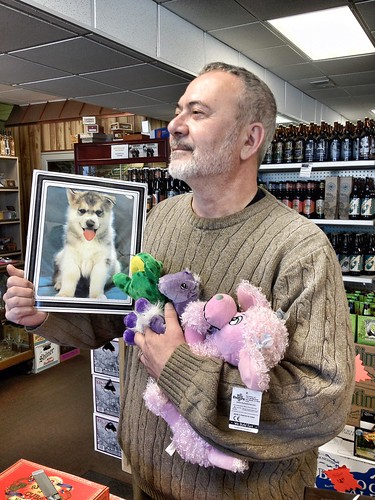
Steve with prizes in all his glory

Tuesday, April 17, 2012

Story of an old mead

By Chris Siciliano

When I met Matt Steigenga, my grandparents' next door neighbor, he immediately offered to crack open and share a bottle of mead almost fifteen years old. That's the way it is with some people, generous through and through.

While the homemade mead was surprisingly good—rich and big-bodied up front, dissipating eventually with distinct and delicate notes of apple—the story of how it came into Matt's possession is even better. Though he didn't make it and he doesn't know the man who did, he counts the man who gave it to him among his greatest friends.

Only a small part of the mead's long history could be inferred from the old contest ID tag taped to the bottle. The remaining story—more to do with friendship than with mead—came out in a series of emails like this one (below), which Matt sent me just today.
"My wife and I met Jim and Wendy Suchy while we were camping many years ago. We saw them walking around with beer steins and thought, 'Those are people we have to meet.' After trying Jim's hefeweizen (Jim is an exceptional brewer) and Wendy’s cornbread I was hooked. We all became great friends and my wife and I visited them in Westland (over by Ann Arbor) many times. 
Jim taught me more about homebrew than any book could, and it was during our visits that Jim introduced me to the beer and mead library in his basement. Being the registrar for the Mazer Cup and I believe for the Michigan State Fair as well, Jim had access to an extensive collection of beer and mead from brewers all over the state/country—rather than tossing anything out, Jim kept the entries that didn't make the final rounds of judging. I would guess he had 20 cases in his cellar. Each bottle had a slip of paper wrapped around it, some on which the brewer's name was written, some with only a number that Jim would have to look up. 
Over the years it became my tradition to venture into Jim's beer library and pull out a few for the weekend while we stayed with them. Some were good and some were not so good. Some didn’t keep their seal and went bad after awhile. The ones that weren’t so great we put into a sauce pan and reduced to make a marinade or sauce. 
With the exceptional meads we went so far as to make contact with the original brewer/meadster just to let them know we appreciated their craft. The one that stands out in my mind is the one where the meadster wrote back. If I remember right it started as follows: 'I write you this almost with tears in my eyes.' The meadster then went on to tell the story of how the mead we tried was laughed at by his local homebrew club and he hadn’t brewed anything since. 
Jim and Wendy ended up moving to Florence, South Carolina and more recently to Bend, Oregon. My wife and I still visit them almost every year over Christmas and New Year’s, each time continuing our mead tradition. On our trip to SC two years ago Jim gave me an entire case to take back to Michigan in order to have a small library of my own. Since then I have taken three or four out and shared them with various people, the 14-year-old mead being the most recent.
Honda used to have a tag line: 'You meet the nicest people on a Honda'. My experience has led me to believe that it should be changed to 'You meet the nicest people over homebrew.'
Strange to think how long and how far that 14-year-old mead traveled before it ended up the focal point in and catalyst for a story on The Buzz. It makes you wonder if one of your own beers, unbeknownst to you, passed from friend to friend to friend, is sitting in some complete stranger's cellar, maybe in Oregon, maybe in South Carolina, waiting for its own story to play out. Cheers to that.

"What? No mead for me?"

Monday, March 26, 2012

Westside store(y): the old shops on West Fulton Street

Our best memories are often place-related and too often those places don't exist anymore. If you, like Steve, have fond memories of a certain localeand of a certain small business in particularin Grand Rapids or elsewhere, we'd love to hear about it. Please share your memories in the comments section below. 

Now a micro-salon, Julie's Hair Place used to be
The Krazy House, a popcorn shop
By Steve Siciliano

I grew up on the lower west side of Grand Rapids where a house on Hovey between Lane and Marion was the center of my childhood universe. When I was very young I wasn’t allowed to venture past those two north-south avenues and so a block-long length of sidewalk served as my playground. I got to know that sidewalk intimately. Even in the dark, with sparks flying off the steel wheels of my clamped on roller-skates, I instinctively knew each section where tree roots created dangerous uplifts that could send a speeding skater tumbling.

When I was old enough to ride a bike my universe expanded. Two blocks west were the ponds, ball fields and wooded hills of John Ball Park. To the east was the Grand River where we fished for carp and sucker off the bridges or for catfish and the occasional bass and crappies from the banks. To the south beyond Butterworth we hunted birds and squirrels with slingshots and BB guns in the expanse of woods that lined the west-flowing river. We thought of Fulton Street, with its collection of shops and stores, as our neighborhood’s northern boundary.

Maybe it’s because I've spent over thirty years in retail that I often think nostalgically about those Fulton Street businesses—the Dairy Queen on the corner of Fulton and Lane where a dime would get you an ice-cream cone, an ice-cold slush or a Dilly Bar; Nawara’s Hardware where the owner would always give deals on the fishing lures displayed in a glass case; the orange and brown A&W root beer stand where they kept the mugs in ice water, where you could get a frothy drought for a nickel and you could take a gallon jug of root beer home for a dollar (a precursor to the growler system employed by breweries today).

On the northwest corner of Lane and Fulton was a little shop called The Krazy House where you could by a bag of butter-soaked popcorn for a dime or Colored Korn or Caramel Korn for a quarter. Up towards the park was Ball Park Shop Rite, a grocery store, and right next to it was Ball Park Pharmacy with its candy and comic books and a soda fountain where you could sit in air-conditioned comfort with a bag of New Era potato chips and a glass of cherry cola.  

The Dairy Queen and hardware store have somehow survived, but the popcorn shop closed long ago and the Shop Rite just this past year. The pharmacy is now a party store and there's a McDonalds where the root beer stand used to be. Change is inevitable but it's not always good. Especially when change leaves nothing but empty space, and memories.

Thursday, March 15, 2012

Mixed blessing: March temps in the mid to high 70s

Not all in West Michigan are pleased with this week's unseasonably warm temperatures.

By Steve Siciliano

“Sure is a nice morning,” I commented yesterday to the old fella who had come into the store for some wine making supplies. If I was more observant I would have taken a clue from the worn bib overalls and the frayed cap with the “John Deere” logo. I would have noticed the worn hands when I handed him his change, the weathered face, and the old pickup truck out in the parking lot. “Not if you’re a farmer,” he snapped back. “You aren’t going to be happy if it freezes.”

He didn’t expound on the cryptic comment and he didn’t have to. I knew he was referring to the fact that the string of unseasonably warm, mid-March temperatures was disrupting the natural rhythms. That if the warmth continued the area’s fruit trees would begin budding and that there was way too much time left for a cold snap to destroy the possibility of a bountiful fall harvest.

I also knew that when he said “you” he was referring to all of us who aren’t farmers and who don’t think about the fact that 70-degree temperatures in March are a possible bane rather than a fortuitous boon. Perhaps he was even specifically referring to us winemakers and cider makers who fret about pH and fermentation temperatures but rarely give a second thought to the weather.

That evening I sat on my backyard deck for the first time in months. I heard the distinctive, whistled phrases of a cardinal and looking up spotted a splash of red high in the bare branches of a maple. I smoked a cigar and thought about all the people who were outside enjoying temperatures that were approaching the 80’s. Then I thought about that old fella walking through an orchard of waking trees, and worrying.

A screen grab from Facebook highlights the difference
in perspective between farmers/growers and the rest of us.
The grab is from this morning, March 15, about 8am.

Monday, February 27, 2012

Learning how to “cleanse” in a dirty world

Christina's Quinoa salad
Former staffer Wes Eaton gives us the dirt on a month-long detox program he and wife recently completed. Wes includes a great-looking Quinoa recipe at the end of the essay. Note that Siciliano's now carries organic Quinoa in bulk ($3.99/lb) as well as the Agave nectar also called for in the recipe. 

By Wes Eaton

I get a lot of strange looks from people when I tell them I’m on a “cleanse.” If they know me, they wonder how I can go day after day without a pint, a sip of wine, some local sourdough, an afternoon square of chocolate, a slice of pizza from Harmony, a morning cup of coffee. People of less acquaintance wonder if I have health problems, or if I feel the need to lose some weight, and fast. The idea of withholding the simple gratifications of good food and drink is somewhat mysterious and perplexing if you see no reason or hear no calling.

When I was younger, I remember my mother would wilt spinach and toss it with vinegar. She liked it because it tasted good, sure, but she also knew that it was good for her, and sometimes she just desired ‘healthier’ foods (why not fresh spinach in a simple salad, I’ll have to ask her). Mind you, she raised us on Butternut Bread, Margarine, and Kraft Mac & Cheese and I’ve had a sweet tooth ever since, one I now nurture with deep red wines, rich ales, and bourbon.

And here I must make a fine distinction as to my motivation to cleanse, as we certainly all must confront our drive to be successful on such a quest. After a hearty season of celebrating, with a follow-up go at moderation, I was still essentially on a trajectory of gourmand decadence. Not in pounds per say, but in my very joints and tissues I felt I was weighted down, a little stiff, and due for an oil change. My hero Jim Harrison often writes about the morning bowl of oatmeal he takes as his penance for partaking too much the night/week before. On my new cleanse, however, not even simple oatmeal was permitted.

In some ways, a cleanse is like a fast. The way substances and toxins, products of immoderation and hedonistic cuisine, build up in one’s body over time, compounded with the unequal and unjust ratio of calories in versus calories expended, I felt I could go a few days without food and be none the worse. This was a romantic—as in fictional—understanding. One gets hungry if breakfast is missed, and by lunch, other options seem worth exploring. After all I did not have a religious calling to sacrifice eating, but rather a desire to freshen up and lose some clinging tension.

I believe in the importance of ignorance, and one of the many ways our Cartesian scientific roots has led us astray is with the false dichotomy between the mind and body, the intangible and the material. The important ignorance here is the conviction that our “self,” as in, how we go about choosing to “be” in this world, primarily comes about from conscious and mental decisions. On the contrary, I feel my whole body is very much part of my mind. And while a fast may lead to religious clarity, or supply the proper lucidity for a vision quest, I needed something more sustainable and doable in the sense of alignment with the other requirements of my life, which presently include reading, writing, and discussingthings that come as a challenge to me on an empty stomach.

The point of a cleanse, however, is not just to counteract individual, personal decisions about what to eat. As any literature on cleansing will remind you countless times, we live in a toxic world. Much of this toxicity can be traced to under adjudicated (as in less than democratic) forms of technologically aided industrial production. Rachel Carson first raised our awareness of the links between environmental degradation and health risks in 1962 with the publication of her book Silent Spring. So a cleanse aims to rinse our bodies of the toxins that come through our skin, or enter with our breath, as well as those we knowingly, or unknowingly, ingest. By cleansing, we heal ourselves of the malicious and creeping side effects that toxins foment.

So unlike a fast, we do eat on a cleanse. But what? There are many cleanse variations. The Master Cleanse, a liquid detox program, prescribes water with lemon, maple syrup, and cayenne pepper for as many days as you can take. Other variations include juice fasting, or blended fasting. Raw Food diets have been associated with countless miracles, and Ayurvedic diets are also associated with detoxification, albeit at a slower pace.

The cleanse I am on, however, is called “Clean” (with a book of the same title). The aim here is to eliminate foods that are difficult to digest or that cause allergic reactions (many of which we are so accustomed to we fail to make the connection between a range of discomforts and our foods). There are two parts to this. First, agitating and loosening toxins from our body. Some of the above practices can do this. But the second part, flushing those toxins by linking them with certain foods is the particular advantage of the “Clean.” This means removing dairy, sugar, most meats, stimulants (caffeine, alcohol), and gluten. 

At first glance this seemed daunting. Not only would I be hungry, but I would quickly need to learn to cook new dishes, and drop the habit of eating out. Instead of BLT’s, egg sandwiches or sandwiches of any kind, spaghetti, risotto, roasts, steaks, burgers, chips and salsa, not to mention IPAs, I would need to get by only on brown rice, raw veggies and fruits, a little fish and lamb, and nuts. While I’ve no room to spell specifics, essentially, going on “the Clean” means fruit smoothie for breakfast (fruit with almond or coconut milk, hemp protein, and cinnamon, for instance), a balanced lunch, such as salad, beans, Dal, veggies, fruit, Quinoa, and another smoothie or bowl of soup for dinner, drinking lots of water, and ensuring twelve hours between “dinner” and “breakfast.”

As I close out the last week of the four week program, I’d like to present some things I felt were key to my success (yes, I made it). The first, and most important, was doing the clean with a partner: my wife Christina. Cooking for one is very challenging, especially when you’re cooking new dishes and can’t fall back on your intuitive stock of kitchen knowledge. Christina studied the Clean book while I simply studied. She selected recipes, made countless lists, trips to Horrocks, winter farm markets, tried new creations, and, most importantly, meal-planned and cooked.

In short, we were thoroughly prepared, which is the second key. The third key was chicken stock, homemade. I often roast birds from the Rakowski’s (regional farmers) and make stock from the carcasses, we used our freezer full for brown rice, soups, and bean dishes, adding savory flavor. The final key was finding dishes that we liked, that were satisfying. For my sweet tooth, mangoes and fresh pineapples have been monumental. For drink, fresh fruit juices and sparkling water. For substance, the indispensable Quinoa. To close, I want to elaborate by sharing a recipe worthy of anyone’s plate. Inspired by a recipe in Clean, Christina made some changes and adapted what’s now one of my favorite lunches.

Christina’s Quinoa Salad
(Inspired by Alejandro Junger) 

    • 3 cups cooked Quinoa (start with one cup dry, try white or red)
    • 1 tablespoon chopper parsley
    • 1 cup currants
    • 1/3 cup chopped raw almonds
    • 1/2 cup diced carrots
    • 1/2 cup mint
    • 1/3 cup chopped scallions
    • 1/2 cup (or more) fresh lime juice
    • 1 1/2 tsp agave nectar
    • 1 tsp ground cumin
    • 1 1/2 tsp sea salt
    • 1/3 cup olive oil
    • Directions: simply mix together and enjoy.

Former Siciliano's staffer Weston Eaton is currently pursuing a PhD in Sociology at Michigan State University. He lives with his wife and dogs in Grand Rapids, MI.

Wednesday, February 15, 2012

In defense of big session

The author, serious about session beer
A "session" beer like Pig's Eye Leanwhat does it have in common with Kraft Mac & Cheese? More than you might think.

By Doug Dorda

Occasionally customers will set a case of Hamms or Black Label on the counter with a look of embarrassment. "Please don't judge me," they will say, only half joking. To ask their reason for concern is to hear some version of the following: "Look at the selection of beers you have, and I walk out with this!" Having heard it so many times now I feel it's necessary to inform our customers that we see nothing wrong with drinking affordable, pilsner-style light lagers. In fact it's just the opposite—I also drink these "session" beers, and so do all my colleagues.

It can be difficult to admit to your fellow beer geek that you sometimes stray from the renaissance of flavor and delve back into the world session beers. I'm no stranger to feeling shame when spotted with a PBR in hand by an ale aficionado I respect. What will they think of me? How will they ever respect me again? It's hard not to ask these questions, just as hard not to fret about the answers.

But I can promise you this, no true aficionado will ever judge you. The fact is they probably won't even remark on the beer you have chosen to drink, but rather join with you in conversation and companionship the same as they would had you been enjoying a fine craft selection. At Sicilianos we try to do the same, and we preach that every beer (every beer) has its time and place for enjoyment.

Contrary to the possible negative perceptions of session beers, they actually offer many benefits to the craft beer drinker. First of all, the beers always taste the same. Each time you reach for a PBR, or even a Blatz, it will taste the same as it did the last time you had it. The craft beer world is full of exciting flavors and stylistic variance, but it can also be a hotbed of flavors that don't appeal to your particular palate. A session beer is like a bunt—it may not be a home run, but it's a tried and true way to get you onto first.

Next, session beers are inexpensive. The average cost of a six pack of craft beer is $10-12. Nine days out of ten most of us would proudly pay this price in the name of supporting the industry we have become so passionate about. However, it's sometimes hard to argue against the sheer quantity of session beer we can afford at a similar price point.

As an added bonus, the modest alcohol content in session beers allows for greater let's call it composure over long periods of time. When I attend a barbecue or house party, I will often bring along a session beer so that I can be a member of the festivities for their duration. These beers also act as great "pacing laps" as I'm fond of calling them. When conducting a taste of many different high gravity craft offerings, I will commonly have a session beer to relax my palate and stave off the desire to drink the higher alcohol beers at a rapid pace.

While musing on this topic earlier I was struck by the realization that session beers are a lot like Kraft Macaroni & Cheese (stay with me here). Kraft may not be the sexiest, most organic, or most delicious food item to end up in your grocery cart, but you buy it every now and then because it's simple, nostalgic, and always the same. So it is for session beers. Though we soldiers in the craft beer revolution wave the flag of passion ever stronger in the face of massive business conglomerates, we may still tip our caps in respect of the big boy's achievements by buying a case here and there.

In summation, buy whichever beer you like, whenever you feel like drinking it. You won't see judgement on our faces. In fact, we'll only thank you for your continued patronage of our store, and thusly, the beer industry as a whole.

Monday, November 28, 2011

Revisiting Wendell Berry's "The Pleasures of Eating"

A good meal is more than just a well-seasoned dish.

By Weston Eaton

This column is all about the pleasures of eating, but I am probably going to talk about pleasure in a way you may not be familiar with. Pleasure has at least two sides: receiving pleasure, which has a gluttonous ring to it when speaking of food, and giving pleasure to others, which strikes me as altruistic. The pleasure I’m talking about below, as related to food, spurns such categorizations, collapsing this dichotomy into a unified practice. I’ll keep it short so as not to preach, but if you find my logic appealing then maybe you too will come to think of pleasure in a new way.

In his essay The Pleasures of Eating Wendell Berry tells us “eating is an agricultural act.” This is a conceptual reminder that no matter how difficult it is for us to see, the food we eat was once grown someplace, and that the very act of eating itself links us to that place and the people there. As eaters then we have certain responsibilities as our actions are linked with both land and livelihoods. Berry’s point is two-fold. First, industrial food is unhealthy for people, animals, and the land. We are disconnected from this type of food: those who produce it do not want us to know how it was produced; they would rather we remained ignorant. Second, and the point on which I want to elaborate, is that eating food is innately connected with what is pleasurable.

What does it mean to take pleasure from food? Of course it has everything to do with taste, smell, the feel and sense of the experience. But can we extend this? Moving into the realm of aesthetics seems fair. This is to say, the company we keep, the background music we play, even the setting of the table contributes to the overall pleasure of the meal. As has been said, beer, for instance, tastes best when shared with people you love and respect. But there’s more. Preparing food, making food, this is an act of creation. We are the creators. We plan, mull over, select, and then act. Our creation is shared and enjoyed. This kind of pleasure reaches beyond the individual. This is a collective act, and in being so it cannot be experienced alone.

But this all takes place after the growth, harvest, hunt, slaughter, or fermentation, each a primary act (before cooking) that can be pleasurable as well. Berry tells us “a significant part of the pleasure of eating is in one's accurate consciousness of the lives and the world from which food comes.” This kind of difference, between knowing your food’s origin and being ignorant to it, is not something that can be measured scientifically—there is no instrument for this. Economically too there is difficulty in deciphering importance. In fact there is little common language for expressing a spiritual connection, as we are no longer much of a spiritual society. But Berry asks us to go here anyway, specifically too for the sake of pleasure. The simple act of knowing is important in itself.

Yet each process that takes place before we cook (or have dinner served) is brutal or violent in its own way. Each takes place “out-of-doors” and miles away from the supermarket, co-op or farm market. Moreover, each process involves "resources" that we ourselves did not create, resources that only require our stewardship and care (and even that may be an overestimation). People, for instance, don't make wine. Yeast does. Seeds become plants independent of the people who planted them. Animals simply are their own meat. We may express our influence upon these things, but we did not create them; they are not borne of our own conception. Soufflé, on the other hand, is something we created.

Perhaps that’s why the acts of agriculture and horticulture are seen by many as brutal. Too often we try to master nature, to make it our servant, to force it to bend to our will. But as Katrina, the Gulf oil spill, the Dust Bowl, Japan's nuclear disaster, and countless floods, hurricanes, and snowstorms have shown, we are not really in charge; in fact, we are hardly in control. And perhaps our desire for control is also the root of our disconnect, our ‘original food sin’, our disenchantment. By acknowledging the limitations of our control, however—and by giving up the infinite options for food provided to us by often faceless corporations—we can in fact become empowered. In the words of Berry, “eating with the fullest pleasure—pleasure, that is, that does not depend on ignorance—is perhaps the profoundest enactment of our connection with the world.”

Is this a zero sum game, practically speaking? Must I denounce much of society to re-enchant my life? Must I pay premiums for “green” food? And what about those who cannot afford it? Change takes place in many forms both small and large. Perhaps the best way to begin answering this question is to meditate on the heart of Berry’s message, which I think benefits from a little explication. Yes, eating is an agricultural act—we eaters are often at the end of a commodity or value chain. But eating is also a social and spiritual act, one enhanced when we learn the origins of food, when we begin to participate, and when we take on the responsibilities of being a good “food citizen”. My point then is that starting to make a change is much better than no change at all.

*Photo credit Mark Siciliano

Thursday, October 6, 2011

Perfect October evening

A glass of homemade wine (or beer) on the back deck is sometimes all we could ever ask for or need.

By Steve Siciliano


If I was an artist I would try to capture the colors on canvas—the golden light from the lowering October sun filtering through the browning leaves on the walnut tree, the greenness of the freshly mowed lawn, the splashes of red, yellow and orange on the tall backyard maples, the fading purple of a few stubbornly clinging clematis and the black speck of a hawk floating high overhead against a cloudless blue sky. But there’s no way a painting could capture the sound of the occasional ground thumps of the heavy, green-jacketed walnuts. Nor could it catch the intermittent squadrons of sparrows bursting from the thick crown of one maple and lighting in another, nor the wide, lazy circles being made by that high floating hawk.

Barb and I sat on our backyard deck sharing a bottle of homemade Noiret that paired wonderfully with the sights and sounds of that perfect October evening. Ellie May, our idiosyncratic but lovable lab/terrier, incessantly snuffled around the deck following the movement of whatever animal it was that had made its home underneath. Every so often I would yell “squirrel” and we laughed while Ellie interrupted her snuffling to bolt out to the walnut tree. Miss Lizzie, the four-year-old golden retriever we recently adopted from the Human Society, lay heavily at our feet. Lizzie has the typical sweet face of a golden retriever but the body of a potbellied pig. It’s obvious that whoever had Miss Lizzie before us fed her a steady diet of people food.

Later there would be a bottle of homemade Foch with pasta and grilled chicken and a Tigers’ playoff game for dessert, all of it a nice way to end a perfect evening in October.

Thursday, September 15, 2011

Winter approaches, and with it opportunities

Riverside Park, January 2011
By Steve Siciliano

I have never been someone who slides into a funk because of the weather but as I get older the idea of wintering in a warm climate has become more appealing. When the weather turns colder, a small, heretofore unheard voice in my head begins suggesting that it would be nice not to have to endure the vicissitudes of another West Michigan winter—the seemingly endless stretches of sunless days, the bone-chilling cold, the times when I have to use a broom to brush off the lake effect snow that buried my Chevy Blazer while I was at work; the icy streets, the slush, the breath-sapping, eye-hurting, nostril-freezing north wind that accompanies the occasional artic cold front. Maybe it’s an instinctual thing. Perhaps that annual, resurfacing voice is Nature telling me that sun and warmth is physically better for a sixty-year-old body and psychologically better for an aging mind. Perhaps it’s the same voice that tells the monarch butterflies, the geese and the hummingbirds that it’s time to get out of Dodge. Perhaps animals are, in some ways, more advanced because they are smart enough to listen.

The other night I was sitting on the deck while the mid-September sun slowly slipped behind our backyard’s western stand of trees. There was a chill in the air—not the transitory chill brought on by a passing front but rather a more permanent, portending chill arising from the sun’s steady progression towards the southern horizon. The light from that southward marching sun filtered through the leaves on the drooping branches of the walnut tree; it reflected off the dying hostas and seemed to magnify the fading greenness of the tomato plants and basil. I thought of how in three months the sun would be a low, unseen speck behind a shroud of clouds, how the ground would be covered with a heavy blanket of snow, and how the branches of the walnut tree would be a tangle of black against a slate-grey sky.

But perhaps we benefit from being immersed in and exposed to the seasons. Perhaps it is change itself that makes us more attuned to the rhythms of life. The animals have no choice but to follow their instincts, but unlike an animal I can throw on warm clothes that will protect me from the elements. A cold wind against my face gives me a better appreciation of the sun’s warmth. Exposure to whites, blacks and greys heightens an admiration for blues and greens. Ultimately it may be better to embrace change rather than succumb to a nagging desire to escape from it.

Winter can present some wonderful opportunities if one learns how to accept it—the thrill of watching snowflakes the size of silver dollars drifting slowly down from the heavens, the stark beauty of a bare branch against a vacant sky, a comforting bottle or two of red wine with a meal on a blustery Sunday afternoon, a hearty stout on a cold night, a bone-warming Belgian…

Thursday, August 4, 2011

Responding to Steve's Fat Tire & Yeungling post

Below are two responses (not objections) to Steve's post "The Mystique of Fat Tire & Yeungling", which appeared on The Buzz on July 28, 2011. A section of the original post is excerpted here. To read the post in its entirety, please follow this link.

Excerpt

"It is a mystery, however, as to why we get so many people [at Siciliano's] looking for two beers that are not distributed in our state, that are not from exotic or foreign lands and that, relatively speaking, are not that highly regarded in the craft beer community—Fat Tire and Yuengling. While these are both solid products from established and successful breweries, they are, in my humble and subjective opinion, no better and perhaps even worse than the beers in the same style that can easily be found on the shelves of any Michigan beer store."

~Steve Siciliano, The Mystique of Fat Tire & Yeungling

A reader responds
(via email, since the comments feature wasn't working)

Yuengling is nothing special beer-wise, just a decent American amber lager. What makes it special is that it's America's oldest brewery, still family owned and making beer in its original Pottsville, PA brewery, six generations after it was founded in 1829 (they also have a brewery in Florida these days). Yuengling has gone through some rough times in the past, but the good people of Pennsylvania have continued to support their regional brew. Since you can get it for about the same price as Bud Light, who can blame them? It's so ubiquitous in PA that you can can walk into any bar and get a Yuengling simply by asking for "a lager." I'm in PA a lot for work and I always have a Yuengling, just to support a historic, regional, and still American-owned brewery.

~Charles Grantier, Kalamazoo

An editor responds

The three years I spent in grad school in Columbia, SC were often marked by nights awash in Yuengling. Back then (and perhaps still) there was no state- or city-mandated last call, and it happened sometimes that my friends and I stopped into a bar around 10 or 11pm, only to emerge hours later, at five or six in the morning, having lost track of time, and having consumed as many Yeunglings as our small teaching stipends would allow.

Why Yeungling?  On some level, it was for those same reasons Charles Grantier expressed above--it's an independent, regional brewery with an impressive history, all of which appealed to us. But we drank it too for more pragmatic reasons: we were poor grad students, Yeungling was a good, relatively inexpensive beer, and you could drink several in a sitting without losing all control.

These days more and more breweries are developing low-alcohol "session" beers, a trend I can get behind. However, as much as I love Founders All Day IPA and beers like it, they are often locked in at the same or comparable price points as other craft beers. While I am both willing and happy to plunk down good money for the quality I get, I believe there still exists an unfilled niche in the Michigan craft beer market: micro-ideology, macro-styles & pricing. It's this niche that Yeungling fills so well in Columbia, SC and probably wherever else Yeungling is sold.

Say what you will, but just as I sometimes hanker for an old ale or flemish red, there are times when an Old Style or PBR is the kind of beer I'm in the mood for--cheap, easy drinking, perfect for a BBQ or Tigers game. But offer me a decent-tasting, low-alcohol, locally or regionally produced alternative at a similar price point, and I will gladly purchase it instead. Whether a beer like this is economically feasible given the financial constraints of running an independent craft brewery, that I don't know. One thing I do know: Yeungling, the oldest operating brewery in the country, seems to be managing just fine.

~Chris Siciliano, The Buzz

The Buzz staff invites all readers to contribute to the conversation. Please feel free to leave your comment below (providing of course we fixed the issue with the comments feature).