View our Main Site »
Showing posts with label featured stories. Show all posts

Monday, June 24, 2013

First-Hand Aid: Bringing Medical Supplies to the People of Cuba

The author with Marc Bohland
By Steve Siciliano

I first met Marc Bohland when he owned The Guest House, a hall on Stocking Avenue in Grand Rapids where a few of our Siciliano’s homebrew parties were held before the annual event outgrew the confines of an indoor venue. Marc also owned the Copper Top at the time and Barb and I formed a friendship with him during our occasional visits to his restaurant. “You should travel with us to Cuba sometime,” Marc said during one of those visits.

Cuba?

Before Marc gravitated to the restaurant business he worked as a surgical assistant in the emergency room at Spectrum Health and it was there that he met a doctor who had recently escaped from the island. The doctor told Marc about the horrible conditions in Cuban hospitals, about the antiquated equipment and about the lack of basic medical supplies. The doctor also told Marc about how his two companions on the inner tube raft had drowned in the Straits of Florida. Most people would have listened and gone back to their lives. Marc Bohland listened and decided to help.

In 1999, Marc and a fellow spectrum employee smuggled medical supplies to the Cuban doctor’s family. That initial and, in the eyes of the United States government, illegal trip to Cuba was the first step in a remarkable journey that has culminated in the formation of First-Hand Aid, a non-profit organization that now regularly, and legally, brings medical supplies to Cuba.

Barb and I made the trip six years ago and it was an extraordinary experience. Like the other travelers in our group, our suitcases were packed with the much needed medical supplies as well as with staples that the average American takes for granted—toothpaste and deodorant, soap and aspirin. We stayed with a Cuban family. We saw first hand what impact the embargo is having on the lives of the Cuban people.

This past Saturday Barb and I worked the cigar bar at “Havana Night,” First-Hand’s annual fundraiser. Siciliano’s market donated the cigars and we donated a few hours of our time as a way of helping the organization continue its extraordinary work.

There are numerous arguments for and against the continuation of the Cuban embargo, in effect now for over fifty years. In the meantime the Cuban people are suffering. Since it doesn’t appear that our government will lift the embargo anytime soon, Barb and I just might have to make another trip.

Learn more about First-Hand Aid by visiting their website and Facebook page.


Thursday, January 19, 2012

Gathering to remember—no, celebrate—a life

Last November the Siciliano's lost a beloved member of the family. Our Aunt Cam succumbed to Parkinson’s Disease at an age when she should have been easing into retirement and spending more time with her grandchildren. Dominic Siciliano, guest contributor and the boss' son, weighs in on the roles that family, food, and drink play in the celebration of a life.

By Dominic Siciliano

Aunt Cam was over most every weekend when my brother Chris and I were boys. As a small business owner and retailer, our father worked every Saturday. Aunt Cam kind of hung out and lent a hand on these mornings. To this day, the sound and smell of percolating coffee reminds me of her.

Above all else Aunt Cam cherished spending time with family. Naturally, as we all gathered for her funeral, it was essential for us to remember her and mourn the loss. Just as essential was for all of us to come together to celebrate her life.

It has always been a tradition in our family to gather at somebody's house in the time following a funeral. Folks first stop off at home and get into comfortable clothing. They pick up food. They pick up homemade wine and plenty of beer and who knows, maybe even a pint or fifth of whiskey.

From the time I was a boy, it was my grandmother and grandfather who would hold this event. I remember running and playing with my cousins beneath the tables, in and around the sounds of my uncles and aunts eating, drinking, arguing, laughing and toasting the family member who had passed.

My grandparents are now eighty-one and eight-two, and with Thanksgiving looming, my dad and Barb stepped up to invite everyone to their house. It's fitting that the first born son would take up the tradition. Actually it was perfect.

Barb laid out a platter of salami, capicola, and provolone. “Whoa! Top-shelf stuff,” my grandpa proclaimed when he walked in to see the spread. Barb had gone to Russo’s to get the meat. “I know what you like,” she told my grandpa. Barb complimented the platter with relishes, hot peppers, olives, and more cheese. Others brought desserts and spicy turkey. Grandma made her garlicy potatoes and beans. It’s a simple country Italian dish—potatoes, green beans and tons of garlic, but man it compliments just about any meal well.

Right away I grabbed some meat and cheese and a chunk of my brother's homemade bread, making up a plate for myself and three of my four kids (the youngest is still a baby). As I worked my way around the table, more family members arrived carrying even more desserts, cheeses, main courses.

I made my way out to the garage where the guys were gathering around a foldout table, sitting on folding chairs and lawn chairs. The smell of spicy Italian sausages on the grill served as backdrop for my first beer. Needless to say, we were celebrating Aunt Cam the right way.

My grandpa opened his homemade Italian red wine and poured huge glasses to place them in front of anyone who didn’t refuse him more than once. My Grandpa Sam may be eighty-one, but he isn’t timid. He poured his own serving—not a dainty one, but a pint glass full, the only thing in front of him—and he began to gulp the homemade vino down.

I chose to attack the eight pack of Vivant Farmhouse Ale that my cousin Jacob brought from the brewery. Both the beer and the glass were cool from sitting in the November air. That first sip was satisfying—the subtle yeasty flavors and hoppy backbone stood straight up against the sharp flavors of the provolone, capicola and spicy pepper olive relishes.

Farmhouse Ale was my go-to beer the entire afternoon. That doesn’t mean I didn’t try the homemade wine that Grandpa continued to pour in waves. Nor did I pass on several toasts of the Buillet, a bourbon my Dad picked up special for the day.

My dad and Barb have a nice space heater that puts out good heat but we would have been in the garage regardless. It was a pleasant day for November and we Siciliano’s prefer to do our drinking outside. Also the old man recently put a dartboard up, just like in the old days, and I try never to miss an opportunity to beat him, especially on his home turf.

Later I took on my Uncle Mark, one of the best, and was actually beating him for awhile. During our game my three daughters came streaming out of the house, their pink and purple winter coats hanging half on, half off their little arms, their mom yelling at them from the door—‘Pull those coats on, zip em up!’ They listened to her and pulled at their zippers a little as they scurried off to run with their cousin. Sure it was my job to watch them but I had other matters to attend to. Uncle Mark was staging a comeback, and anyway with their older cousin looking out for them the girls would be just fine.

I’m not sure my girls even knew why we were gathered. I do know that they were having a great time, running back and forth from the cold, smokey garage to the warm room in the house where Grandma and Aunt Laurie were holding court with the other cousins and babies.

Through all this no one lost sight of the reason we were there—to remember and celebrate Aunt Cam’s life. Aunt Cam’s stories. Memories of her and Uncle Pete weaved their way through each game of darts, through all the drink and food and conversation. I brought out some old photo albums from the 1970’s and we laughed at the clothing and the hairdos.

Funny, the people in the photos, although all looked younger, all had changed only a little. And some had passed away. It's the events in the photos that reveal the layers of tradition that make our family what it is, how food and drink is almost always front and center—at weddings and funerals, on trips Up North, during Saturday morning coffee sessions, at Sunday dinners, dart and ball games, reunions and trips to the beach.

And through it all was Aunt Cam, the person for whom we were gathered. We miss her and we wish her peace, and that day we celebrated her life the right way, the way we celebrated the aunts and uncles, the grandmothers and grandfathers who had passed on before her.

We hope she smiled down on us and approved of the gathering. If I know Aunt Cam, she was happy with the party.

Friday, April 22, 2011

Rowster: new American coffee? Lets hope so

By Chris Siciliano

A version of the following post is scheduled to appear in the May, 2011 issue of Recoil Magazine.

“Soft on the palate, with subtle undertones of blackberries.” To walk in on the above conversation mid-sentence, you would think Kurt Stauffer was not describing coffee, but rather his favorite bottle of wine or, more likely, this being Michigan, a new summer beer from Shorts, Bells, or New Holland Brewing. The fact is, Stauffer, expert coffee roaster and owner of ROWSTER New American Coffee, was describing his popular Burundi roast, and doing so with such delicious-sounding descriptors that all within ear-shot began to salivate like Pavlov’s dog.

Stauffer’s enthusiasm for good, let’s call it craft coffee, is matched only by Stephen Curtis’, sitting vice-president of Rowster and barista extraordinaire. One small-batch, custom roast at a time, these two are doing for coffee what others have been doing for craft beer for the last twenty-five years: reminding us that drinking and eating too need not be purely utilitarian activities, but can (and should?) be moments of complete transcendence and, for some, the culmination of years of study, obsession, and fervent attention to detail. Like the brewers at Founders, the bakers at Nantucket, the chefs at Winchester and Vivant, like any number of craft-anything pioneers across the city, state, and country, the guys at Rowster are hell-bent on achieving mastery in their chosen field, which, in this case – and lucky for us – just happens to be coffee.

Lucky too that Rowster moved recently from their original back-room location on Cherry into a spacious storefront in the up-and-coming Wealthy St. business district. It used to be you could only buy Rowster coffee by the pound for at-home consumption. Now, thanks to the new larger space, you can enjoy it by the cup as well. Just be sure to have a few extra minutes when you go. Rowster sets out no self-serve carafes to expedite service, nor do they have an honor jar for customers who don’t have time to wait. These things, though sensible, even appreciated in other coffee houses, would be completely out of place at Rowster, where each cup of coffee is brewed individually, to-order, and not until the customer asks for it. The decision to put quality above all else, including convenience, might sound like utter sacrilege to those who subscribe to the prevailing fast-food sensibilities of our time, but Stauffer and Curtis would have it no other way.

The single-cup, “clever coffee” brewing system employed by Rowster has several advantages. Nothing if not efficient, it delivers just about the smoothest, most well-balanced coffee you can find. It also ensures quality by virtue of freshness. (Like most things, coffee degrades the longer it sits around, not a problem at Rowster.) Again, the goal is not speed, but rather the enjoyment of delicate, naturally fruity flavor compounds otherwise locked within the coffee grounds. By catering exclusively to taste Rowster stays true to their governing philosophy: done correctly, a good cup coffee can (and should) be so much more than merely a vehicle for caffeine or sugar. It can be a culinary experience no less thought-provoking than a rare Belgian beer, yet no less accessible than, well, a cup of good coffee.

This philosophy informs not just their brewing process, but the roasting operation as well. Instead of over-manipulating the raw or “green” coffee bean to achieve some pre-determined end, Rowster uses the tools available to highlight and tease out the implicit character of the bean itself. It’s their opinion that exceptional coffee, like good wine, comes from careful production practices, sure, but more so from terroir – that is, the environmental factors in which the bean was grown. The region, the variety, the processing, the weather, these variables matter as much if not more than what Stauffer and Curtis can do on roasting day. In a sense, the guys do their best simply to get out of the way, letting the natural complexity and potential of the bean lead them where it will.

This is not to say they don’t have their own style. In the same way a microbrewery or winery or even a restaurant strives to establish a defining or overarching flavor profile, Rowster too strives to cultivate a unique identity across every roast in their bullpen. Their coffee, no matter the variety, tends to be on the lighter side, bright with sparkling acidity; this as opposed to the heavy-bodied, chewy coffees available from other roasters, which are no better or worse, just different. Stauffer likes to think of his roasts as “over-achievers”, coffee that pleases with balance and subtlety rather than boldness and brutish intensity.

In any case, it’s coffee worth checking out, by the pound or by the cup, both options are available. Espresso, cappuccino, and other drinks are available as well. ROWSTER New American Coffee is located at 632 Wealthy Street SE, two blocks west of Eastern.

Kurt

Steve

 The real star of the show

Sunday, April 17, 2011

A tribute to a beer-loving golden retriever

By Steve Siciliano

I was finishing an order when Barb called.

“Cody’s not good,” she said.

“I know.”

“He’s bleeding pretty badly.”

“I know.”

That morning at home I had watched Cody, our golden retriever, licking his paw while he lay on the tile floor next to the back door and it was then that I knew it was time. The more he licked the more the tumor on the lower jaw inside his mouth bled. Two weeks before, Dr. Chudy had removed a similar tumor but in those two weeks another had grown. “I’m quite sure it’s cancer,” he told us after the surgery. “We’ll just have to see what happens.” When I left for the store that morning, all the fur on Cody’s left side was red.

I knew it was time but I was hoping that Barb was going to tell me that she was able to once again stop the bleeding. When I got home she was crying. “Do you think I should feed him before you go?” she asked.

“No.”

I had to lift Cody into the back of the Blazer. That had nothing to do with the cancer. He was just too old to jump that high anymore. In two weeks he would have been fourteen.

While I drove I thought about snippets from Cody Joe’s life—about the time he busted through the screen door trying to get at a squirrel, about the time we came home and found shredded books on the floor of the living room, how he would pick my socks up off the floor and proudly present them to me as if they were birds, how he loved the water, how he loved retrieving tennis balls, how he loved chasing squirrels up the back yard walnut trees, how he would follow me from one room to another and lay at my feet, and how during backyard store parties he would walk around tipping over glasses, lapping beer from the ground with the same enthusiasm of any life-long beer geek. Like the rest of us, Cody Joe loved his beer.

In one of the private rooms in the clinic I sat on the thick carpeted floor with Cody’s head in my lap. I caressed his head while the tumor bled on my hand and arm. While we waited I thought about the first time I had to do this, almost thirty years ago. I thought about Winston, an English setter, standing on a cold examination table. I was shocked at how fast the pentobarbital worked, and I tried holding up Winston's collapsing, dying body. I wasn’t going to let that happen to Cody.

I had my cry on the way home. It was a good cry. Cody was gone but I still had his memory.

Later that evening Barb and I went to Founders. We sat at the bar and somehow it felt good to be surrounded by people. It felt good to be sitting in a familiar place, surrounded by familiar faces, drinking a good beer, every so often talking softly to each other about Cody. A familiar pub is a good place to sit when you’re happy, but it’s also a good place to sit silently in sorrow.

When we left the sun was just dipping below the horizon

“Beautiful sky,” I said.

“It is,” Barb replied.

I looked at the rays of light reflecting off the crimson clouds. “Maybe Cody’s out there somewhere,” I said.

Barb put her hand on my arm. “Maybe he is.”

Friday, April 8, 2011

Not just beer, wine geeks too

By Steve Siciliano

Long before I understood IBUs, Belgian quads, or the difference between ales and lagers, I developed a fascination for wine. That fascination eventually matured into love; but my first exposure to a premium wine, a German white that I happened to arbitrarily pluck off a shelf while in college, was akin to a fuzzy cheeked, virginal teenager having a serendipitous encounter with an older woman—the experience was exciting, a bit intimidating, stimulating, a little overwhelming, and I just wasn’t quite sure how to do things right.

I was fortunate that the wine I haphazardly chose contained a little sweetness—lucky because if I had happened instead to have picked out a huge, dry, tannic red for my first blind leap into the world of wine my virginal palate, which up to that point only had experience with Boone’s Farm (wine’s equivalent of a giggly school girl), might have been shocked beyond reparation. I don’t remember much about that wine besides the fact that I was intrigued by the experience—intrigued not only by the complex flavors and aromas of the wine itself, but also by its other, non-sensory elements. I remember gazing at the unfamiliar words on the high-sloped, amber bottle wondering about the grapes that produced that wine, what they looked like, where they were grown, and what alchemy it was that turned those grapes into that alluring, straw-colored liquid.

Over the subsequent years I continued to be fascinated by wine but whenever I approached it I did so with a degree of trepidation. One day I brought home an armload of books from a used bookstore and began an extensive, exploratory journey through the world of wine. I traveled first around France and devoured information about the big, long-lasting wines of Bordeaux, the velvety smooth reds and the crisp, flinty whites of Burgundy, the beefy, inky Rhones and the delicate whites of Alsace and the Loire Valley. I stepped briefly in Champagne, crossed over the border to Germany, moved on to Greece and Italy, and ended that journey in the hills of Spain and Portugal. One thick, oversized book had enticing colored photographs and I was transported to impressive chateaus surrounded by acres of vineyards. I studied gnarled vines poking up through gravelly soil, gazed at huge wooden barrels resting in arched stone cellars, floated over Burgundy’s gentle slopes and looked down on the impossibly steep vineyards of Germany. I got lost on the wide plains and in the rolling hills of Italy.

Shortly after returning from that journey I spent the night with a Beringer’s Knights Valley cabernet sauvignon. Unlike the inexperienced young man who was intimidated by a semi-sweet white, the knowledge and experience I had gained allowed me to know exactly what to do with that dry, tannic red. I knew how to approach it, how to appreciate it, how to gaze at its physical beauty and how to breathe in its complex aromas. That was the night I fell in love with wine.

That love was one of the reasons I sold the neighborhood convenience store I owned at the time. It was a good store, but I knew if I were to stock premium wine there the bottles would have only gathered dust; and because I had fallen in love with wine I wanted to sell it.

Because of the number of beer related posts that appear in The Buzz, regular readers may have the impression that the only alcoholic beverage that we at Siciliano’s are passionate about is beer. While beer put us on the map, we still love talking about wine and we love selling it. Future Buzz posts about this alluring, fascinating and complex beverage will prove this.

Thursday, March 31, 2011

Photo essay, road trip to SW Michigan

By Chris Siciliano

For weeks now this editor has done little else but carry on about Siciliano's forthcoming grain & flour department. Until recently I haven't had much in the way of tangible news to report. That all changed last Friday when the new flour mill arrived. Today I'm happy to relay even more good news -- we currently have sitting in the warehouse (though not yet for sale) several hundred pounds of whole grains, seeds, salt, sugar and flours.

The product arrived in-store Tuesday evening, not by UPS or FedEx delivery, but thanks instead to an intrepid crew of Siciliano associates who sacrificed their afternoon to secure the goods in person from a distributor in Southwest Michigan. And when I write "sacrificed the afternoon", I mean of course "barhopped all the way home". What can we say? At Siciliano's, even a bag of flour is just cause for celebration.

For photo highlights from the trip, please keep reading.

First stop: The Pullman Tavern (Pullman, MI). Here the fearless crew sampled this year's Oberon under the watchful gaze of (1) an actual Tyrannosaurus Rex; and (2) a misty temptress from times long-past.


Next time you're in Pullman, it's worth stopping in


An actual T-Rex eating an actual human hand


Oberon - the first sign of Spring...still waiting on Spring


Authentically Kraeusened - says so right on the label


The patriarch


The legendary temptress of Pullman


Second stop: Clementines (South Haven, MI). Wherein the crew enjoyed a mystery porter, admired a intricately-carved wooden eagle, sampled a previously unknown (to them) Michigan cider.


The intrepid crew


A pleasant discovery


Every bar should have one


Cheetah in the mirror


Mystery porter


So awesome it deserves a second look


Third Stop: The Thirsty Perch (South Haven, MI). Wherein the crew dined on many delectable fishes, and chicken wings.


Not to be confused with the Parched Perch, which is
a completely different restaurant


Circle of life, little perch, circle of life


Fourth stop: Saugatuck Brewing Co. (Saugatuck, MI). The crew was impressed by the quality of beer -- it's a brewery definitely worth the visit.


Great place for a pint


On-premise brewing


Brew kettles and such


Fifth & final stop: Siciliano's Market warehouse. Special thanks to the bossman Steve for getting everybody home safely (he's always the responsible one).


Product piled high in Siciliano's warehouse


Look for Siciliano's new flour/baking department to be up and running soon!

Friday, March 18, 2011

Enter not, lest ye be judged


By Chug Dorda

We are now accepting entries in the 8th annual Siciliano's homebrew competition. As such, I thought it would be wise to de-mystify the process for those thinking of entering. First off, our competition is a BJCP sanctioned event. This means that all beers entered must be submitted under a style category meticulously decided upon by the BJCP board. A list of categories with specifications can be found at the official BJCP website (http://www.bjcp.org/stylecenter.php).

Secondly, your beer will only be judged against its own category for the first round of tasting. Say, for example, you enter a pale ale. Until "Best in Show" consideration, your entry will only compete against the blanket style definition of "pale ale", not against every other pale ale entered into the competition. This is done to assure an accurate, unbiased evaluation for that beer alone -- not a relative comparison to others in the competition, but an objective comparison to a well-established set of style guidelines.

The reason behind adhering to style categories is simple: it helps remove personal prejudice from the judges and assures an unbiased evaluation of the particular beer in question. When a judge samples a beer, he/she is asked to compare it to approved standards of aroma, taste, and presentation which are considered perfect for the category. (For brewers who intentionally manipulate a beer beyond the accepted parameters of a certain style, there is always category 23, the "specialty" beer category, a catch-all for entries that don't fit into any other category.)

Most important to remember is that the judges are not there to criticize your beer; rather, their mission is to offer an array of notes, constructive criticism, and suggestions on how to tailor a beer more accurately to its intended style. Often times I have recommended that someone enter a beer they are trying to perfect in order to gain perspective on it. I have also suggested that a beer brewed exactly to style be submitted in order to test its mettle, perhaps to go on to "Best in Show" consideration. 

You may enter whatever beer you like of course, but I would offer a simple tip before making the final decision. Set aside six to eight bottles of the beer you intend to enter. On the night before the competition starts, conduct a taste panel with a friend while reading the style guidelines. You may be surprised at what you find. For instance, a beer brewed to robust porter guidelines may turn out to be a brown porter, a presumed IPA could be closer to a pale ale, and so on. This simple step could be the difference between a medal winner and the ultimate prize, the award for best in show.

Beers will most often be judged by a team of two. There will most commonly be a BJCP certified judge (or an otherwise well-qualified palate) teamed with a less experienced, but highly educated “beer geek". The team will compare notes after each judge has completed his/her initial and separate tasting. The dichotomy of information presented is extremely useful more often than it isn't. Judges will decide the beer's final score together, and together they will offer their final impressions of the beer (see score sheet below). I have seen judges write, “If this were in a store, I would buy it tonight!”

If this is your first time entering a competition, and you are unsure of what will happen, I can only guarantee two things. First, you will receive amazing tasting notes that will undoubtedly be useful on your next brew day. Second, it will further fuel a fire of passion within you, one that will not be calmed until you have made the perfect beer. Although it is a “competition”, we at Siciliano's would like people to view it more as a celebration of their achievements in beer making. You already make good beer, the only thing left to do is make it better, and make more of it.

Cheers, The Chug.


Official score sheet - click to enlarge


The Chug
Sicilano's staffer Doug "the Chug" Dorda lives on the west side of Grand Rapids, where he is in the final editing stages of "Category 23", an epic, 12-volume work of beer- and space-related science fiction.

Sunday, March 13, 2011

Memorable meals: aboard Amtrak 370, the Pere Marquette

By Chris Siciliano

At precisely 5:20pm on a Tuesday afternoon, Amtrack 370, the Pere Marquette, with service from Chicago to Grand Rapids, pulled away from Union Station. An hour later, as we rolled past the rusted-out, starkly beautiful landscape near Gary, Indiana, Gena and I unpacked the various foodstuffs collected that afternoon in downtown Chicago. The meal, arranged haphazardly on the fold-down trays in front of us, included these tasty tidbits:

  • A small container of Tuscan bean salad in pesto dressing and a good chunk of Parmigiano-Reggiano, both purchased at the small Italian eatery across from our hotel.
  • A generous wedge of rustic bread, which the counter lady at a Belgian bakery sliced from what had been, earlier in the day, an enormous 4- or 5-lb loaf. By the time I got there, only a quarter of the loaf remained, and I took half of that.
  • An olive medley from a gourmet shop in Old Town. This place had bread for sale as well -- good-looking baguettes with excellent caramel color -- but I resisted the bread here in order to visit as many different food shops as possible.
(Included on this list should have been two cans of Wisconsin-brewed Simpler Times Pilsner, which, for the money, is a surprisingly fresh and flavorful beer. In my haste to check out on time, however, I left them in our hotel room's mini fridge. Hopefully the maid enjoyed the beer just as much as we would have.)

If it seems a simple meal, that's because it was, made memorable for precisely that reason: simplicity. Ripping chunks from the crusty bread to use in lieu of silverware; popping olives one by one into our mouths, not knowing exactly where to put the pits; breaking chunks from the hard, crystalline cheese with our fingers -- it doesn't get more basic. Nor does it get much better. I'd be lying to say the train itself did not add tremendously to the experience.

Why is it this relatively short ride from Chi-town to hometown filled me with such nostalgia? Considering how few times I've traveled by train in my life, and how long ago (ten years or more), you'd think the experience for me would be a novel one. Instead the ride felt oddly familiar and even comforting, as if the trip is one I often make, which, of course, is not the case at all. 

When my grandmother was a girl, she and her sisters and their father went to Detroit each year to watch the Tigers play. When they went, they went by train. She tells the story sometimes and I think my train-related deja vu exists as a direct result of it (her story) and others like it. Much has changed since my grandmother's day, and though the rate of change only accelerates, there remain certain important touchstones between then and now, the train being one of them. Unhurried yet unrelenting, it plods across the land with the same insistent, steady rhythm that it plods across both time and our imaginations.

A welcome answer to the frenetic pace of life today, traveling by train not only connects us to the past, it allows us to slow down and enjoy the simplest of things, a meal of good bread, cheese and olives most of all.


View from the train: pickle vats, Bangor, MI


Goose Island, Honker's ale, Chi-town's own


Our first stop


Don't care who you are, that's impressive


City at night

Chris Siciliano is a writer, teacher, and managing editor of the Buzz. He lives in Grand Rapids, MI, the last stop for the Pere Marquette departing from Chicago. All photos courtesy of Gena Max.

Friday, March 11, 2011

Wes interviews Sam from Dogfish Head (2008)


Roughly three years ago -- long before The Buzz existed -- future correspondent and all-around good guy Wes Eaton put a call in to craft beer ambassador Sam Calagione of Dogfish Head. The resulting interview first appeared in the May, 2008 issue of Wide-Eyed, an arts and music magazine published in California. The interview is reprinted here (with permission) for the benefit of our loyal readers, the overwhelming majority of whom do not live in California and, as a result, probably missed it the first time around.

Editor's Note: Some may question the wisdom in posting a Dogfish interview when so few of their beers are available at Siciliano's (due to complicated distribution issues). To that we say, there is no spoon. Enjoy the interview!

In 1993 Sam Calagione homebrewed his first batch of beer. The craft beer scene at the time was limited and underground; Calagione was about to help change that. He looked around, checked to see which way the mass beer trends were flowing, and decided to swim upstream. No light lagers for Dogfish. Instead, to distinguish his creations, Calagione opted for candied fruits, old-world spices, continuous hopping regiments and parameter-shattering abv’s. Two years after his first homebrew, Calagione opened Dogfish Head Brewings and Eats in Rehobath Beach, Delaware. Back then he brewed ten gallons batches, an output more in line with homebrewers than commercial breweries, and one positively dwarfed by current operations.

In the spring of 2008, Dogfish Head invaded California with a line-up of three big beers: 90 Minute IPA, a continuously hopped Imperial IPA; Midas Touch, a honey- and saffron-flavored, Muscat grape- and barley-based elixir inspired by the ancients; and Palo Santo Marron, a strong Brown Ale aged in massive (and expensive) Paraguayan wooden vats. As evident below, Calagione’s Yankee ingenuity and rugged individualism epitomizes America’s artisan food and craft brewing cultures.

Wes Eaton: Would you give us some back story to your experimentation with non-traditional ingredients with some culinary insight?

Sam Calagione:
Sure. When we opened in 1995 we were the smallest commercial brewery in America. At that time there were 800 US breweries. I researched what I wanted to do, I was just kind of a manically obsessed home brewer and back in my apartment in Manhattan I was creating beers while I was writing my business plan. I was always trying to make beers like nothing that was out there. Then, just as now, the domestic beer landscape was dominated by three breweries: Miller, Coors and Bud, and they’re all essentially making very slight variations of the exact same product: a light lager beer. So I knew from the get-go I had no interest in brewing those kinds of beers. That’s when the concept of off-centered ales for off-centered people came about. Basically, we’re never going to appeal to the majority of people out there, so let’s just have fun and brew for ourselves, and hopefully there’ll be a growing community of hard-core beer folk that want to explore the outer-limit of what beer can be. We opened our restaurant with a tiny, inefficient, ten-gallon brewery, and we had to brew two, three times a day, that small scale allowed me to experiment without too much risk. I’d go into the kitchen of the restaurant and take some coffee or raisins or licorice root and incorporate them into that day’s brew. Our reputation for brewing exotic brews came from those humble beginnings.

Eaton: Talk about the relationship between wine and beer. What do you want people new to this crossroads in alcoholic beverages to understand?

Calagione: Wine culture is further evolved than beer culture in America. The average consumer understands that an amazing bottle of Merlot can justifiably cost three times as much as a crappy bottle. That same consumer is just now beginning to understand that an amazing four-pack of wood-aged, 12% abv beer, fermented with organic brown sugar, as is the case with Palo Santo Marron, can still be a great value at three times the price of a six-pack of generic lager. The West Coast is recognized as the premier wine region in America and the average consumer in that region is more open to the idea of approaching beer with the same respect.

Eaton: How do you think your distinct beers will be accepted here in California?

Calagione: It actually helps us that the wine culture is so evolved on the West Coast because our beers are very wine-like in their flavor profiles, alcohol content and their food compatibility.

Eaton: You’re known to many as a poet, builder, brewer, filmmaker and writer – was brewing the key to the actualization of your passions? How do you define yourself?

Calagione: I’m the brewer first; the rest of the stuff is just hobbies. I mean for me they all kind of augment the making and the selling of beer. I write the books as educational programs and components which teach people how to brew and get comfortable with drinking beers that have non-traditional ingredients. I try to teach people just what Dogfish is, that’s sort of what the first book is about (Brewing Up a Business), and then He Said Beer She Said Wine is all about making wine people comfortable appreciating and understanding good beer in the context of food and beer people understand wine in the context of food.

Eaton: I read Raison D’Etre was designed as a beverage that would be the ultimate complement to a steak dinner. Is food pairing always this important at Dogfish?

Calagione: Yeah. Right from the beginning we knew that we were going to be brewing beers that were a lot closer to wine in alcohol content, complexity and food compatibility. The best way to highlight that was to pay careful attention to what foods we recommended pairing with each of these beers. Since we opened as a restaurant brewery, we also had the ability to feature on our menu the idea that for every great food item there is a perfect beer match. A lot of times, like in the case of the Raison D’Etre, we were actually designing beers backwards from what would be the ideal partner in the food world.

Eaton: Beyond beer, Dogfish distills distinct spirits which stress the definition even of “Extreme Beer.” Are these natural evolutions of continued fermentation exploration or intentional directions for Dogfish?

Calagione: We use our mission statement as a dynamic compass. If you pull out the word “ale” and put in “distilled spirits” it still rings true. We’re not doing what the big distilleries do; we’re following our own path as we do in our brewery. In the case of a distillery product like our Brown Honey Rum, (which is) aged on honey while it sits in oak, which is very unique, it’s perfectly in keeping with our vision. Our distillery is 1/1000th the size of our brewery, but it’s still a fun little project that we think adds vibrancy to what Dogfish Head is all about.

Eaton: Dogfish is also known for its historical and ancient ales like Midas Touch and Chateau Jiahu, talk about these experiences and recipes.

Calagione: Certainly the majority of our recipes come from our own inspiration, we think about which unique ingredients will work in a beer that have never been used before. But we sort of stumbled into being this specialty brewery for ancient beverages, and that’s right up our alley. (Ancient recipe beers) are like liquid time capsules. They allow people to come face-to-face with the history of civilization, not just the history of fermented beverages. In the case of our Chateau Jiahu, it’s got a 9,000 year pedigree and is recognized as the oldest known fermented beverage. This also silences the naysayers about the validity of “extreme brewing” because it shows that at the beginning of civilization people were making really exotic, multi-fermentation sugar source beverages to celebrate special occasions. Therefore, Chateau Jiahu has sake yeast, sake rice, and hawthorn fruit. Midas Touch has honey, grapes and saffron. We’re doing another ancient ale with the oldest known chocolate discovered in Central America. Before humans were eating chocolate they were drinking it as a fermented beverage. The beer (called Theo Broma) therefore has Chilean cocoa nibs, cocoa powder and tree seeds and is coming out in August.

Eaton: There is a culture clash within the brewing and drinking community over the ambiguously termed "Extreme Beers". Talk about your role in formulating these out-of-bounds beers. When you began brewing high gravity, sugar- and spice-infused exotic brews, did you know you were taking part in the next movement of the American Craft Beer Revolution?

Sam Calagione: I don’t think it was anything that conscious. Our motto of off-centered ales for off-centered people wasn’t really derivative of anything of the mid-nineties. Nobody was focused on strong, exotic beers when we started. We were considered sort of side-show freaks and black sheep, like what we were doing was novelty. But again, as beer culture started to evolve and expand, this niche within the greater craft brewing niche became extreme brewing. While we didn’t come up with that term for it, [extreme brewing] was all that Dogfish did since the day we opened. Our brewery was recognized as a pioneer within that niche.

I don’t think there’s that much backlash (against extreme beer.) There are a few isolated brewers who don’t like the term, but at the end of the day it’s not really up to us to give it a name, it’s up to the consumer. It’s sort of an elitist position to rebuff extreme brewing because the people have spoken and they want these kinds of beers. Look at the growth of breweries like Dogfish, Russian River, or Allagash, who brew these exciting and unique beers which people really enjoy. Beer is subjective. No brewer should be so elitist as to determine for people what they should be drinking.

Eaton: Nine years ago the storied “Beer Hunter” Michael Jackson and you spent a day together. Raisin D’Etre, Chicory, Shelter Pale and Immort Ale were already on your menu and a new 30-bbl brew house was being constructed. Talk about the changes you have seen in our beer culture since then and your contribution to this dynamic enclave.

Calagione: In that era, Immort Ale was among the first wood-aged beers and it was [also] exotic, incorporating maple syrup, peat-smoked barley and vanilla beans. Frankly, we could barely give it away. Nobody was willing to pay $13.00 for a six-pack of beer, so we had a real tough time. We started as the smallest brewery, today we’re one of the fastest growing breweries, and I think the 35th biggest brewery in the country out of 1400. While I’m proud of all that growth, what I’m most proud of is that we never discounted or dumbed-down our beers in order to achieve growth. That shows that while we’ve been very lucky to be able to stick to our original mission and achieve this incredible growth, it’s really indicative of how far the average beer consumer’s I.Q., experimentation and interest level has come.

Eaton: As you and Dogfish Head redefine the term “beer”, do you find the conventional terminology frustrating or do you see it as a necessary challenge?

Calagione: Frustrating. Not because of a few people who take shots at extreme beer and want things to be like they were 100 years ago, but because our government is very restrictive in the licensing process. When we go to get a beer label approved or new beer brand that has a non-traditional ingredient they make you go through a million steps. They’ve very subjective on their definitions. For instance, they will not let us call the Theo Broma an ale, even though it’s fermented with ale yeast. Because of all the special ingredients we need to call it a “malt beverage”. That undermines what we’re doing. “Malt beverage” sounds very generic compared to “ale”. The bureaucratic hoops that we have to jump through just to present these unique beers are stifling.

Eaton: What really makes a craft beer craft beer?

Calagione: Three things: craft beer comes from an independent brewery with no ownership from a big brewery and is made by a traditional brewery which uses barley or exotic, more expensive and flavorful sugars and not the cheap rice and corn that the big breweries use. Also it has to come from a small brewery, defined by the Brewer’s Association as less than two million barrels (annual production). The consumer wants to know where their beer is made in the same way that they want to support their local coffee roaster, local baking company and to buy locally. The big breweries are seeing the small craft breweries growth and that that’s where the excitement in the beer industry is. They’re trying to co-opt that growth and in essence act as culture vultures and try to confuse the consumer as to what real craft beer is.

Palo Santo Marron is an example of what Dogfish Head is all about. There’s no precedent for it. All other breweries are aging beers on oak, kind of the go-to wood of the beverage industry for malt whiskey, wine or beer. We do some beers in oak, but we found this really exotic wood from Paraguay. A high-end flooring salesman brought us some samples and we did a test batch and aged some beer on it. It has really high resin content and the alcohol, which acts as a solvent, strips the natural oils from the wood and we found that it imparted this amazing, unparalleled, caramel, vanilla character to the beer. So we went for it, went all out, and built the biggest wooden brewing vessel made in America since before prohibition out of this exotic wood. Each tank that we built cost $110,000. The return on the investment in this tank in measured in decades not even years, but we’re a private company we don’t give a shit. We’re not being held to investors to make more profits every quarter. This is a labor of love. While this is a very expensive project, it’s one that we believe enhances what our company is all about. Will it ever sell as well as 60 Minute I.P.A. or Raison D’Etre? Probably not, but we don’t care; it’s just another beer that we’re excited to drink and we’re glad people are excited to try it as well.

Eaton: I’m excited; I’ll be drinking that one tonight.

Former Siciliano's employee Weston Eaton is currently pursuing a PhD in Sociology at Michigan State University. He lives with his wife and dog in Grand Rapids, MI, where once upon a time Dogfish was not the rarity it is today.

Monday, March 7, 2011

Weaning ourselves off the bottle: craft beer goes can


By Greg 'Swig' Johnson

Chances are if you frequent Siciliano's Market or any other quality beer store you've noticed the slow but steady influx of craft beer varieties packaged in aluminum cans. Over the past several years, the use of aluminum has been adopted by around 100 craft breweries in North America, with more breweries steadily signing up. In Michigan, Keweenaw Brewing in Houghton leads the canned beer revolution. It seems appropriate that a brewery from the UP -- the land of hunting, fishing, and other outdoor can-friendly activities -- would race to the forefront of this up-and-coming packaging format. Other breweries aren't far behind, however. Arcadia, Shorts, and Vivant all have plans to can in the near future.

Not to be outdone by their west-side brethren, a number of east-side breweries have already made the move to aluminum. MillKing It! Productions in Royal Oak, Those Guys Beer in Lake Orion, and Rochester Mills Brewing all offer their beer in cans. Out of state breweries with canned beer for sale in Michigan include Big Sky of Montana, Breckenridge of Colorado, Shiner of Texas, Brooklyn of New York, and Cucapa from Mexico, just to name a few. It is also worth noting that, in addition to what you already find on Siciliano's shelves, more quality imported canned beers are becoming available all the time.

Some might question the wisdom of packaging beers in aluminum cans. Won't the beer taste like metal, or worse? Well, the answer is simple: no. Modern aluminum cans with a neutral lining are being considered throughout the industry as a better package than the long-preferred glass bottles. The advantage of aluminum is complete protection from light and oxidation. Glass bottles, no matter how dark, will allow some light to get in. Even if it's only small percentage of UV light, a small percentage over a long enough time will still result in beer being "light-struck" (skunked). Since no light penetrates aluminum, you could theoretically leave a beer in the middle of the Sahara Desert for a year and it will not develop any characteristics of being light-stuck (though it might not be much good from the heat).

The other significant benefit of aluminum cans is that they are 100% enclosed with no seals that can experience degradation. With glass bottles, the cap and the occasional cork present a weakness for ensuring the stability of a beer by protecting it against oxidation. Cap seals can degrade over time allowing oxygen to slowly seep into the beer, creating papery, wet-cardboard, or sherry-like off-flavors in the beer. Degradation of the cap seal can be accelerated through repeated warming and cooling of bottles and intensified by wildly fluctuating temperatures.

Aside from better protection for your beer, cans also offer some fringe benefits. They are lighter and more compact than bottles which decreases freight costs and lessens oil consumption during transport. With regard to recycling, cans are the superior choice because the process for recycling aluminum is more efficient than it is for recycling glass. Some reports also indicate people are more likely to recycle cans than they are glass. Cans are also more break-resistant; whereas glass will often shatter when dropped, cans will just bounce or dent. Moreover, there are the recreational conveniences rendered by cans -- they cool more quickly than bottles and can be taken places where you can't take glass.

It might be difficult for some people to overcome their psychosomatic responses to canned beer and alter their affinity for glass containers. For those individuals, I invite them to perform a blind tasting of cans versus bottles with a beer that is available in both formats (such as some Big Sky, Shiner, and Brooklyn). Evaluate the appearance, aroma, flavor, mouthfeel, then provide overall impression of and preference between the two beers. The results could be surprising.

As canned beer becomes more prevalent in the craft beer world, embrace its presence and the beery goodness that lies within. The next time you're tubing down a river, dropping a line in the pond, catching some rays on the beach, or find yourself in a place where glass bottles might not be welcomed, grab up some cans of good craft beer, hold them high above the generic swill surrounding you, and enjoy.

Additional Reading:
  • Bottles vs Cans - An article about the benefits of canned beer
  • CraftCans.com - An independent website dedicated to the news and reviews of canned craft beer.
  • beernews.org/category/beer-cans/ - Beernews.org is a website dedicated to providing the latest beer information. This is specifically a link to all postings related to craft beer in cans.

Siciliano's staffer Greg Johnson has a real can-do attitude. He lives and brews on the west side of Grand Rapids, MI, where everything is aluminated.

Sunday, March 6, 2011

A personal history of bread and baking

By Chris Siciliano

Roseburg sourdough
The first time I baked bread was in early September, 2008. Gena and I had just moved into a house in the Rosewood neighborhood of Columbia, South Carolina. Cola-town, South Cackalacky. The official home of boiled peanuts (awesome) and Palmetto Bugs (not so awesome). This was our first place together and already we were less than enamored of our landlord. Not a bad guy, just more enthusiastic in his landlording than we were used to, stopping by often and without warning. It was our first place together and we knew already that, despite our landlord, we had made the right decision. Gena planted tomatoes and zucchini beside the garage out back. I watched the backyard pecan tree with anticipation, waiting for the nuts to fall, not yet knowing how well they would complement golden raisins in the rustic French farm loaves I later taught myself to bake.

The first time I baked bread I was just beginning my last year in graduate school (English), working on my thesis, taking two classes, and teaching another. I spent most of my day at the computer, pecking out page upon page of lesson plans, essay analyses, essay responses, emails to students, professors, classmates, family, friends, etc, etc, etc. Only occasionally did the tap, tap, tapping of the keyboard taper off into oblivion, and if that awful keyboard-silence marked the end of something, it was more likely the end of my rope than it was the end of my daily workload. I've heard it said that graduate school is not like real life, that real life exists only outside the boundaries of the University. Real life or not, in graduate school the work is difficult and unending and it often turns your brain the consistency of bread dough. Now that it’s over, I find I sometimes miss it badly.


Whole wheat pecan golden raisin


The first time I baked bread I needed distance from the essay I was writing. Pacing the house from room to room, I was looking for a way to divert my attention: a worn-out baseball glove and tennis ball; a guitar played poorly; recurrent visits to the ever-tempting bounty of the refrigerator—almost anything would do, even the glossy pictures in an old cookbook. Two weeks earlier, a friend had gifted Gena a book about bread, an outdated relic from the 1970’s and something I’d totally ignored until then. In it though were wonderful full-color photographs of obscure (to me) breads and pastries, pretzels, bagels, and flatbreads. Captivated by those delicious-looking photos, I decided to try a recipe, the first and supposedly easiest in the book: basic Italian white bread. Who knew that from just one loaf full-blown obsessiveness would emerge.

The first time I baked bread I used too much flour. I didn’t know how to measure correctly and, when the recipe called for three cups, I packed them so tight it took damn near an act of congress to get the flour loose again. Not surprising then that the dough was far too stiff to knead easily and ultimately made for an overly-dense, too-dry bread, much like an aromatic paving stone. But man alive did that stone taste wonderful! Gena likened it to the rustic, crusty loaves she ate while studying years ago in Malta. I noticed similarities, albeit distant, to the perfect bread of my memory, the bread my grandparents made—and still make, five loaves at a time—for us grandkids on holidays, get-togethers, and weekends up-North. The golden crust. The creamy white crumb. And the smell. The slightly nutty, slightly sweet aroma of, well, fresh-baked bread. There's simply no better way to say it.


Roseburg sourdough crumb


Big eared bread


Humans and cereal grain and even yeast must have co-evolved, adapted over millennia to work together perfectly, a team on which each member does its part to improve upon the whole—grain to provide the sustenance, yeast to make it more palatable and to preserve it, humans to organize and endlessly replicate the dance. A triangle so beautiful even Pythagoras would blush. For my money, beer is evidence enough of this symbiosis. But if you’ve ever smelled a kitchen during bake-day, you’ll notice something elemental seeping phantom-like through your neural pathways, a scent to call up the shadowy specter of early civilization, even times before. If Ben Franklin was right and beer is proof that God loves us, then fresh-baked bread is proof that heaven exists—what else could smell so good?

And this is why, on some level, my first homemade loaf of bread left me feeling troubled. When I pulled it from the oven, I was absolutely astonished to find that the recipe had worked, that I had made bread—bread!—in my own kitchen, with no special equipment, and with only four, readily available ingredients: flour, water, yeast, salt. No factory necessary. No machinery. No chemicals. Until then I didn’t think it any more possible to make bread at home than I thought it possible to build my own car, or refine my own oil, or compose my own symphony or…well, you get the idea. The problem though is that bread is so easy. Flour, water, yeast, salt. Mix, knead, rise, bake. That’s it. That’s all there is to it. There are nuances, sure, and ways to complicate the process. But there is no mystery. Why is it then I believed that producing bread, the very staff of life, was beyond my ability, that like a new pair of socks, bread could only come from (a) my grandmother or (b) the supermarket. This disconnect bothers me still. And not just a little. It makes me wonder what else I can do. It makes me wonder why the disconnect at all.

The first time I baked bread was an experience nothing short of revelatory. I was proud of my inaugural loaf to an absurd degree, misshapen and dry though it was. A more recent attempt produced not one but three loaves, and not your basic white bread either, but rich-tasting five-grain sourdough with flax and sunflower seeds. These were much better tasting than that first historic paving stone, and better looking too. Anyway, I’m hooked now, thoroughly addicted to the pursuit (and defense) of good bread. It sounds crazy I’m sure, but to me, when I really think about it, there are few things more important. It’s the staff of life, for crying out loud. What could be more vital?


Five-grain sourdough


Unabashed breadhead Chris Siciliano is a writer, teacher, and the managing editor of The Buzz. He lives and bakes in Grand Rapids, MI, where there's always something rising. A version of the above post appeared last year on Chris' now-defunct blog, The Bread Defender. Reprinted with permission.

Friday, March 4, 2011

New England style cider: the slow road to good drink

Buzz contributor Wes Eaton explains the process of making “New England” style cider, in his words, "a golden drink with a strong acid backbone yet pleasant apple flavor achieved through a slow, 'stressed' fermentation process".

By Wes Eaton

In days gone by, farmers would press their apple bounty into large, barn-stored wine barrels, allowing the raw cider to ferment slowly and naturally, making a strong but sweet beverage for consumption over the winter and cool spring months. Dried fruit was added for sweetness and strength, but this played a dual role as its presence also helped clear the beverage. I like to emulate this process in my home cider brewing, especially the cold fermentation stage, which is key to coaxing raw cider into a balanced and full-bodied elixir rather than an alcoholic, tepid and flabby mouthwash, so often the product of hot, vigorous fermentations. To put it more straight forward, here’s how I go about making my cider.

Attack of the giant carboy!

Once home with your cider--five or six gallons makes a worthwhile batch--sanitize your brewing pail and fill it to just beyond your target volume, say five and a gallons, leaving room enough for the yeast to rise. The extra volume is necessary as you'll lose some cider after fermentation when you siphon it from the primary bucket into the air tight glass carboy for its conditioning phase. Take a reading with your hydrometer next and note the specific gravity and potential alcohol in your record book. With no additives, my batch this year came in at 1.050 S.G., with a potential alcohol of 7%, meaning that if all sugars are converted, I’ll have a decently warming beverage. Like wine, cider “finishes dry”, meaning that all of the available sugars in solution will be eaten by the yeast, yielding a final gravity reading of below 1.000, the gravity of water.

When your fermentor is full and gravity reading recorded, your must is ready for inoculation with yeast. There are other steps that many cider makers take at this stage--testing the pH, testing the acid and making adjustments, or adding sulfites to sanitize your must from wild yeasts. Let’s leave those steps for more advanced, future batches and move straight ahead to adding the yeast. Knowing the quality of the source of your cider is key to this step [see note below], as is a little faith that good-tasting raw cider will yield great-tasting hard cider. There are many yeast options available, but I suggest a dry American or English ale yeast such as those offered by Safale. If you are a beer brewer or wine maker, it's here you would snip and sprinkle in the entire package. Not so with cider, not with New England-style cider anyway, and here's why.

Look closely: you can almost see the raisins.

Adding the standard, full-size shot of yeast (typically one package) induces a quick, healthy fermentation where the sugar is converted into alcohol over the period of days and the resulting drink must be moved quickly off the spent yeast cake. This standard fermentation, while perfectly functional, drastically changes the flavor of the raw cider, dissolving the taste of apples and accentuating to taste of alcohol. To slow this down, there are two things the old farmers figured out long ago: add only a little yeast, say a 1/4 tsp per five gallons (if any at all) and ferment your cider in a cool place, preferably between 46-56F. Simply sprinkle your yeast on the surface and attach your lid and airlock. Next, look for a cold spot in your home, like a back stairwell, cellar, three-season porch or closet on an outside wall. If the temperature temporarily drops, that’s okay; your yeast is hardy! [Editors note: both the author and Siciliano's recommend keeping your cider at room temp (68 degrees) for a day or two after pitching the yeast and before moving it to your "cellar" location; this allows the yeast to gain a necessary, if tenuous foothold.]

By this process you achieve a “stressed” fermentation -- metabolization (yeast multiplication) and alcohol conversion happen slowly, gradually, over an entire season as opposed to a number of days, thereby preserving the flavors of your carefully blended apples and providing the perception of sweetness and body despite a technically dry-finishing beverage. Let this happen in a brew pail or, if you’d rather see the colors move from leather to copper to gold, let your cider ferment in a glass carboy. You’ll know when it's time to transfer by noting this color change. As the cider begins to clear, sometime around late winter or early spring, slowly siphon the must off the now-dormant yeast cake and into a clean carboy, making sure that the carboy is topped-up to prevent oxidation from contact with air. Your cider has now undergone its long, slow primary fermentation and has been moved into a secondary vessel; it's time now to add a final ingredient: raisins.

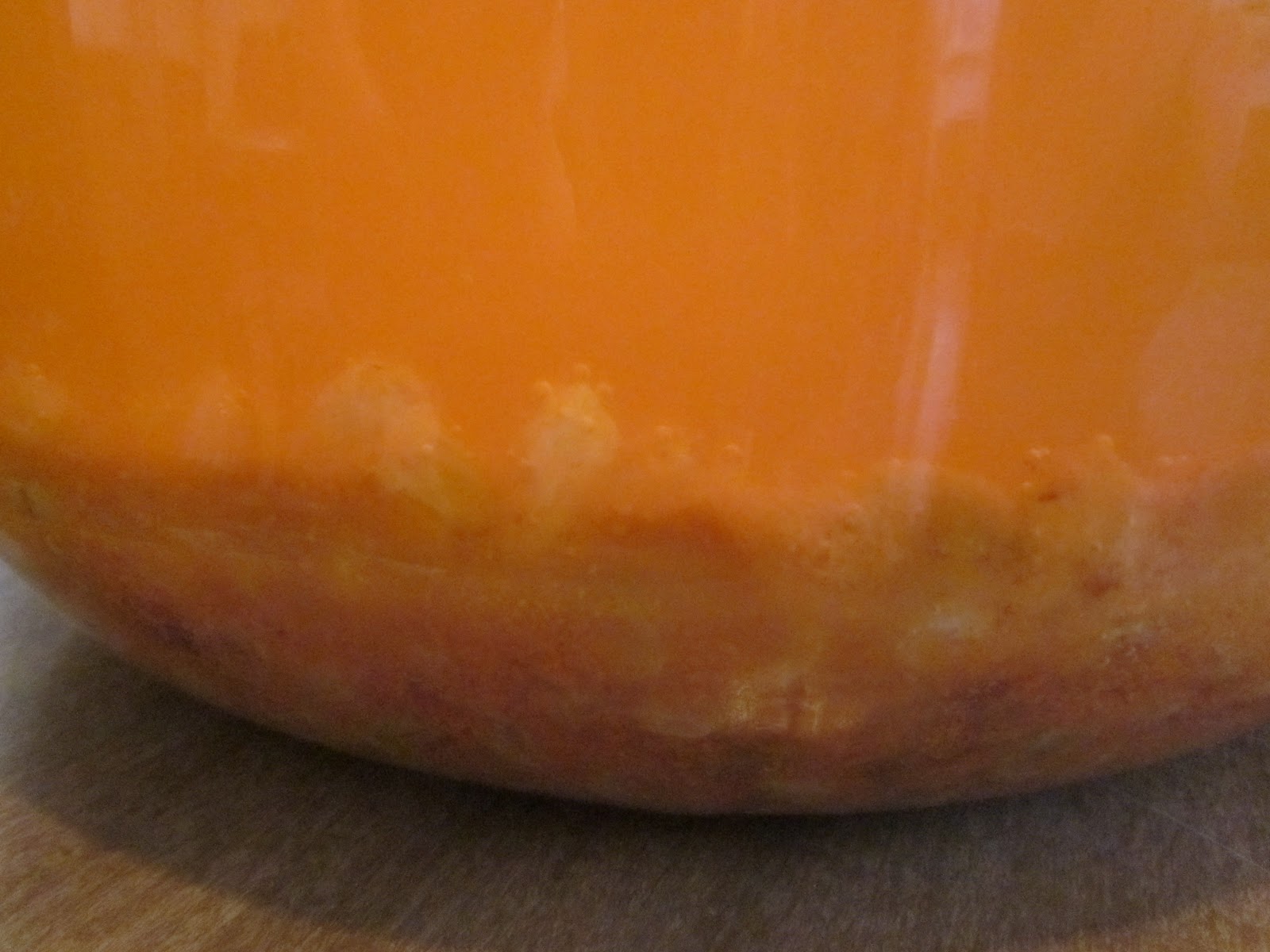
Orange: fruit & hue.
As noted, the tannins found on raisins contribute to the desired translucence and also add both body and sweetness. Since your remaining yeast is now dormant, stressed into submission from their uphill battle against the cold, sweet wort, the concentrated sugars found on the raisins add delicate and complex flavors of plumbs and figs, ultimately enhancing the perception of apples. Specifically, I use organic white raisins. Whatever you use, be careful to choose raisins not coated with vegetable oil, a common additive. Add about a half-pound, then top up the vessel, attach your airlock and let age as long as you can, at least one month.

Your cider can then be packaged either still (non-carbonated) in bottles or racked into a home kegging set-up. To make your bottled batch sparkling, you’ll need to add fresh yeast along with 1/4 cup of corn sugar boiled and cooled in a cup of water before bottling. The result is a sparkling, golden elixir, the hue of honey, with the aroma of a summer apple orchard and taste of a crisp Fuji on a hot, summer afternoon. While this is only one way to approach making cider, this is my favorite, and I hope you too enjoy this patient and rewarding method.

Black & white for dramatic effect
*Regarding ingredients: Hard cider starts with sweet or raw cider, which is called ‘must’ or ‘wort’ by brewers, as is any unfermented fruit- or barley-based liquid. Preferably, your cider will come from an orchard and mill close to your home, one which blends the juice from a variety of acidic (tart) apples, such as Jonagold, Golden Delicious and Ida Red, with those of the sweet, sugary sort, such as Macintosh. My source is Hill Bros. Orchards & Cider Mill northwest of Grand Rapids. Winner of multiple awards for the raw stuff, Hill Bros. accommodates the amateur cider maker like no other, offering to fill buckets or even bourbon barrels with their continually-tested blend of four or five varietals, sold below three bucks a gallon well into the new year. While theirs is highly-prized cider, most any fresh, local cider will do, as long as it has not been pasteurized (UV pasteurization is fine).