View our Main Site »

Friday, June 29, 2012

New Beer Friday - June 29 Edition

By Chris Siciliano

You've probably heard by now—ten area breweries have teamed up to create one epic brew to honor Grand Rapids' recent naming as Beer City, USA. Beer City Pale Ale, a red pale ale brewed with nugget and cascade hops (all from Michigan), was devised by brewers through a collaborative process and will be on tap at most GR breweries throughout July. You can read more about it here.

At Siciliano's, we happen to think communal efforts like this are a pretty good idea, and we'd like to see them continue. In fact, this whole Beer City Pale Ale things opens up a great opportunity for discussion—if it became tradition for GR's breweries to all make the same recipe once each summer, would you like to see that recipe change from year to year, or would you rather have consistency? For that matter, what style of beer do you feel most represents our small corner of the world (West Michigan, that is)? Feel free to express your opinion in the comments section, which you'll find just below the list of this week's new suds.

New (and Returning) Beer

  • Flying Dog Underdog Atlantic Lager, $1.79/12oz - "UnderDog is light and refreshing with crisp hop lage and pairs best with foods like simple salads, provolone and Monterey jack cheeses, seafood and light proteins" (source).
  • Flying Dog Pearl Necklace Oyster Stout, $1.79/12oz - "A dry stout brewed with Rappahannock River oysters" (source).
  • Flying Dog Wildeman Farmhouse IPA, $1.79/12oz - "Brewed for Bierproeflokaal In de Wildeman’s 25th Anniversary. This brand new brew is an unfiltered American IPA hopped with Citra and fermented with Saison yeast" (source).
  • Flying Dog Woody Creek Belgian-style White, $1.79/12oz - "This unfiltered and traditionally spiced Wit beer is brewed with coriander and bitter orange peel" (source).
  • Short's Spruce Pils, $1.99/12oz - "This Imperial Pilsner, fermented with local, hand-picked blue spruce tips is the quintessential symbol for Joe Short’s love of hops and craft beer. The spruce presence, rooted in historical brewing practices, is enormous and gives the beer a refreshing quality reminiscent of gin. This beer is impressively light bodied, considering the immense spruce flavors and the prodigious additions of hops" (source).
  • Great Lakes Wright Pils, $1.79/12oz - "The Wright Pils, a classic pilsner style with a flowery bouquet and elegantly dry finish, is named after the Wright brothers who invented and built the world’s first successful control airplane (WARNING: Please do not operate an airplane while enjoying this brew!). The Wright Pils is light and crisp, but not too light for true craft drinkers (5.3% ABV and it’s a pilsner people). Serve as an aperitif or pair the brew with salads, salmon, tuna and marbled meats" (source).
  • Breckenridge Imperial 72 Chocolate Cream Stout, $3.29/12oz - "Rich, toasted chocolate with hints of dark fruit" (source).
  • Breckenridge Summerbright, $1.79/12oz - "The craftsman's touch combines white wheat, two row pale and munich malt with the pacific northwest's most intriguing hops to create a bright, clean ale ideal for picnicking, evenings on the screen porch and enjoying the whims of the summer breeze" (source).
  • Left Hand Good JuJu, $1.99/12oz - "Fresh ginger kisses the lithe malty body, copulating with the hop in this pale ale ancestor" (source).
Picture of the Week
IMG_3170
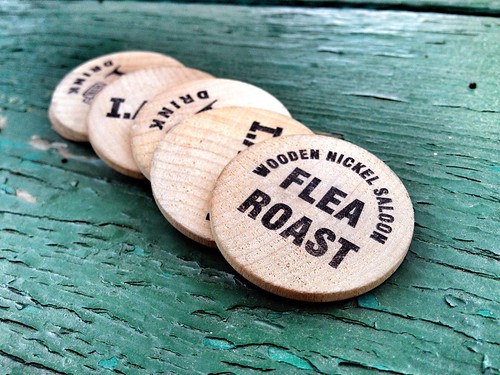
Beer tokens for the world-famous Flea Roast in Irons, MI.
Have you ever been?

Cheers!

Wednesday, June 27, 2012

The Wisdom of Vito Brunelli

Fiction by Steve Siciliano

In exchange for the six hours he spent raking leaves at the Dominican convent Vito Brunelli got a ham sandwich, a twenty dollar bill and a holy card with Raphael’s crucifixion on the front and the Serenity Prayer on the back. He stuck the bill in his pants pocket, the holy card in his shirt pocket and tossed the half-eaten sandwich to a dog that was licking a Slim Jim wrapper on the sidewalk in front of C’s Convenience Store. He leaned on the five iron that he used for a cane and rubbed his aching right knee before going into the store for a package of Bugler cigarette tobacco and two fifths of Wild Irish Rose.

Two hours later he stumbled into a clearing next to a stretch of abandoned railroad tracks where three men were huddled around a camp fire passing a bottle. He sat at the base of a small tree, took a long, final swig of wine, tossed the empty bottle in a high arc towards the tracks, then took the pouch of tobacco out of his shirt pocket and began rolling a cigarette. “Hello you lousy, drunken bums,” he said.

“This here’s a private party,” said a man who was sitting on a ripped lawn chair and poking at the fire with a stick. “Ain’t no cheap ass wops allowed. Ain’t that right, Lennie?”

Lennie was standing next to the fire warming his hands. “He can stay if he got more wine. You got more wine there, Vito?”

“If I did I wouldn’t share it with you bums.”

“Look who’s calling us bums,” said another man sitting on a five-gallon bucket and looking at a Hustler.

“I think there ain’t nothing worse than a cheap ass wop,” the first man said. “I ever tell you guys about them cheap ass wop tires?”

“Shut up with that damn joke already, Dugan,” said Vito.

“Dago through mud, dago through snow…”

“Shut your trap,” Vito said again, “or I’ll run this here goddamn five iron down your throat.”

“…and when dago flat, dago wop, wop, wop.”

When Vito was trying to get up Lennie reached over and grabbed the five iron. “What you going to do now you cheap ass wop cripple?”

Vito knew it could have been worse. He felt lucky that he had gotten out of the fight with only bruised ribs, a sprained right hand and a swollen left eye. He felt lucky even though Lennie broke the shaft of his five iron against a tree trunk and now, leaning against the iron railing outside the Catholic church, he felt lucky that it was raining. He knew the rain would make him look even more forlorn and more forlorn meant more money in the tattered baseball cap he was holding. Vito waited for the people to file out after the Saturday evening Mass, and when he took the pouch of Bugler out of his shirt pocket the holy card came out along with it. Leaning against the iron railing in the cold, steady rain, he read the Serenity Prayer in the light of a flood lamp.

While he limped in the rain down Division Avenue, the change heavy in his pocket, his knee hurting, his ribs aching, Vito Brunelli prayed that God would give him the courage to change the things in his life that he could and the serenity to accept the things that he couldn’t. He knew that he had enough money in his pocket to get his cane back from the pawn shop. That would be a start. He imagined that if he tried real hard there were some things that he could change; other things it didn't much matter what he did, the change would never come. When he was in front of the house where he rented a room he stood on the sidewalk trying to decide which was which. Then he limped across the street to the convenience store, and thanked God for giving him the wisdom to know the difference.

Tuesday, June 26, 2012

Rye Whiskey - For All the Rye Reasons

IMG_3184
By Steve Siciliano

In the Academy Award winning film The Lost Weekend (see trailer below), Ray Milan won an Oscar for his portrayal of an alcoholic writer who goes on a three-day drinking binge. Strictly from the perspective of a purveyor of packaged spirits, I find it interesting that the booze Milan’s character imbibed on his bender was cheap rye whiskey.

Until recently one would have a difficult time finding enough rye on liquor store shelves to get a good buzz on let alone fuel a weekend drinking spree. Rye at one time was the predominate whiskey in America, especially in the northeastern states, but after prohibition it gradually sank into obscurity. It is now being produced again by a small group of distillers and is making a small yet noticeable comeback.

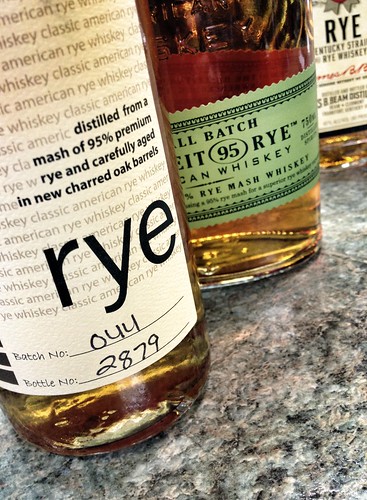
In order for whiskey to be designated as “rye” in the United States it must be made from a mash consisting of at least 51% rye with corn and barley making up the remaining ingredients. It is distilled to no less than 80 proof and is aged in charred, new oak barrels. The preponderance of rye in the mash imparts distinctive, spicy notes to the whiskies that are noticeably drier than those made predominately from corn, wheat and barley. Siciliano’s currently has three rye whiskies from three different distilleries on the shelves: Jim Beam Rye ($19.97), Bulliet Rye ($25.95), and Redemption Rye, ($28.98). All come in 750ml sizes.

While it is doubtful that rye will ever replace Bourbon and blended American or Canadian whiskeys in popularity, its distinctive flavor offers a fine alternative, either as a straight sipper or as the main feature in a variety of classic cocktails.


Monday, June 25, 2012

Tasting with multiple bodies

When it comes to tasting craft beer, context is king.

By Weston Easton, Professor-in-Training

In this short tale, I’d like to explore the way one thinker has changed the way I experience taste on an everyday basis. In a yet-unpublished book chapter, Annamarie Mol writes about taste as being a lynchpin between the physical world of nature and the intangible world of human society. She roots this suggestion in the physical act of tasting, which, she argues, is a bodily act as much as it is a human social and psychological experience. Moreover, Mol uses this act of tasting to make an argument about the body: the idea that the body is multiple. 

Here’s how this works. The argument is actually quite simple. Yes, our bodies are whole things. But if we trace the way we taste (keeping in mind the definition above) from one situation to the next, this changes. The body becomes multiple as it too varies situation to situation. Her example is that we mobilize taste differently in different contexts. She gives the cases of tasting for poison, as undertaken by tasters screening the dishes of ancient emperors, of tasting to acquire specialized knowledge about food and drink, or tasting to eat less food, or to eat enough. So then our bodies, as represented here by taste, change in different contexts and situations.

I think this idea is interesting and useful for people who think deeply about the food they eat and the beer they drink. Or better yet, for recognizing that people who do think deeply about things such as craft beer probably do not always taste in the same way in every context. Let me give an example. Think about some of your favorite beers. Do they always taste the same? My bet is that you, like, me, experience variability from beer to beer, even if its the same brand or label. When the taste is different, do you ever wonder whether this is do to a chemical difference as much as a difference in place, company, or mood? These questions deal with expectations.

Another set of questions might get at intentions. Do we always drink or eat for the same reasons? I think this is especially important for craft beer drinkers. Our kind are known for seeking out new tastes and getting excited about new horizons. But we’re also known for being painstakingly nuanced and distinguishing tasters. When we are tasting a craft beer, we are deliberate in our intentions: we evaluate the beer based on a certain set of standards or criteria. The point here is to recognize that in craft beer culture, taste has been mobilized as a highly specified (think style), codified (IBU’s), and standardized (see BJCP.org) practice, the aim of which is to objectify taste—an act Mol shows to be a highly subjective and contextual thing. At the same time, taste (in beer) has also been transformed into a symbol of who we are as people, what our food values and ethics are.

Why point this out? For one, I think its important to recognize that the way we interact with craft beer is a specific thing. We do not mobilize taste the same with craft beer as we do, say, with water. We use personal discretion, but this discretion is not entirely of our own devising. Moreover, in different contexts, we taste differently. As others have recently pointed out, even craft brewers themselves do not always drink craft beer. PBR, for instance, is popular with West Michigan brewers as a “good corn beer.”

A brewer is an especially good example of the way taste operates differently in different contexts and of how the body is multiple. Brewers' professional identities depend on creating distinguishable tastes consistently, yet they themselves drink outside of their own brand’s portfolio. Tasting sweet wort, a brewer uses all her skills to adjudicate and determine if the specimen meets established standards. Yet out in the tap room, he/she may drink a pint for either “quality control” or for simple relaxation. These shifts are bodily shifts. Using the example of a latte or other coffee drink, Mol points out that treats like these provide our bodies “a break from working” where instead of trying to “master the world” we can “just live” and “be appreciative.” The latter could certainly involve corn beer.

So, for me at least, thinking about Mol’s point—that we mobilize taste differently in different contexts, and that our bodies are therefore multiple and contextually located—has led to a new personal mantra: be aware of the different ways I mobilize taste. I like to think of this as a first step. A successive step is to reflect back on how the way I (consciously or unconsciously) mobilize taste steers my preferences and intentions and therefore my body/mind’s experience of taste. Said differently, we get what we’re looking for with taste, and are therefore capable of fooling ourselves even before we do any actually tasting.

Friday, June 22, 2012

New Beer Friday - June 22 Edition

Snapseed By Chris Siciliano

It's officially summer. Siciliano's recommends you celebrate the fact appropriately by following these simple steps. (1) Peruse the selection of new beers located on the list below. (2) Mark, check, highlight, or otherwise indicate the beer(s) from the list that you most want to try. Feel free to mark all of them. (3) Tell your boss you have a dentist appointment. (4) Stop by Siciliano's to purchase beer in the necessary quantities. (5) Play hooky for the rest of the afternoon. (6) Repeat steps 1-5 every Friday until September.

New (and Returning) Beer

  • MacTarnahan's Spine Tingler Golden Belgian-Style Triple, $5.79/22oz - "A surprisingly sublime Belgian-style triple offering an electrifying blend of spicy aromatics balanced with a lively malt palate that is so good it's scary" (source).
  • Victory Summer Love, $1.79/12oz - "With the sublime, earthy familiarity of noble, American and German hops backed up by fresh and clean German malts, Summer Love Ale® ends with a surprising burst of lemony refreshment from fistfuls of American whole flower hops. Love Summer, now" (source).
  • Sprecher Black Bavarian Lager, $2.59/16oz - "This intensely dark Kulmbacher style lager has a superb malt complexity with the distinctive flavors and aromas of coffee, caramel and chocolate. A renowned smoothness and a creamy, tan head make it an all-time brewery favorite" (source).
  • Sprecher Hefe Weiss, $2.29/16oz - "This coarse filtered wheat ale is fermented with a German yeast culture for a refreshingly light spiciness and hints of citrus fruit. A cloudy appearance and an immense creamy head are characteristic of this lightly hopped Bavarian brew" (source).
  • New Holland Golden Cap Saison, $1.79/12oz - "Golden Cap Saison is a modern interpretation of a traditional farmhouse ale. A soft, pale beer, Golden Cap embodies the flavors and aromas of summer fields. Brewed with an ancestor of wheat called spelt, its straw-colored body, lively carbonation and a unique fermentation profile evoke fresh cut hay and cracked peppercorn" (source).
  • Round Barn Summer Wheat, $1.79/12oz - "An unpretentious American pale wheat beer, our Summer Wheat pours a cloudy golden-orange, just like a sunset over Lake Michigan. Its assertive wheat flavor is complimented with hints of citrus zest. Garnish with a slice of orange or lemon" (source).
  • Echt Kriekenbier, $4.19/11.2oz - "This refreshing ale is based on Vichtenaar and has the aroma of Kirsch cherry brandy, smooth, vanilla-like oaky palate and late surge of passion-fruit flavors with some acidity. Local sour cherries are added during the maturation process to the wooden casks containing Vichtenaar. The final product is a blend of 1, 2 and 3 years old beers" (source).
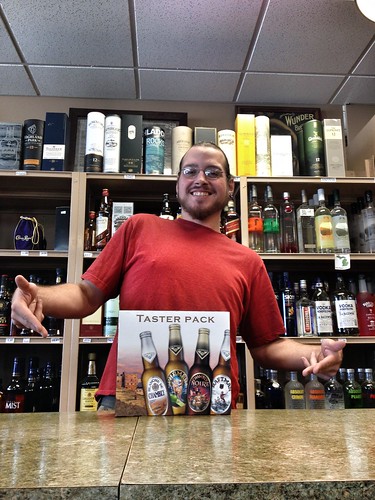
  • Unibroue Taster Pack, $11.29/(4)12oz bottles - "Taste our Legends"
      • Blanche De Chambly - "Subtle bouquet of spice, citrus notes, aromas of yeast breads, coriander, and cloves" (source).
      • Ephemere - "Delicate balance of fruit and spice, hint of sweetness, hint of tartness, redolent of Granny Smith Apples" (source).
      • Chambly Noire - "Smooth roasted grains, mildly smoky notes , and spices (cloves, green anis, mint) with a chocolaty finish" (source).
      • Raftman - "Smoked malt whisky, low acidity masked by a caramelized apple flavor with a taste of fine yeast" (source).
Photo of the Week

IMG_3160
Impromptu tasting at Pike 51 Brewing Co.
By the way, they now have about this many beers on tap,
give or take.

Wednesday, June 20, 2012

Deal of the Week - Don Manuel Villafañe Keltehue Malbec

IMG_3148
By Chris Siciliano

Good things come in small packages—that old saying is never more accurate than when the package is a bottle and the good thing is wine.

Sicilliano's featured deal this week is a half or "split" bottle of a delicious Malbec from the Mendoza region of Argentina. It's called Don Manuel Villafañe Keltehue Malbec 2009 ($4.49/375ml) and while clearly not the best choice for dinner parties, the smallish size makes perfect sense for picnics or your favorite outdoor summer concert series (providing the park rules permit alcohol, that is).

What's the one drawback of a half-sized bottle? This wine is so tasty it'll be gone before you know it. That's why we recommend buying two. Or three. Or, well, you get the idea. At $4.49 per bottle, you can afford to buy in bulk. Here's the full description from the label.
Our talented ancestor Don Manuel de Villafañe began making wine in Argentina in the year 1611. It is in his honor that we have created a superb line of wines representing the finest varietal grapes of Maipú, Mendoza. We think he would be very proud.
Malbec is the backbone of the Argentine wine industry for a good reason, it is fantastic. The grape that came from Cahors near Bordeaux has found its perfect home in Argentina, and more specifically in Mendoza. This is an absolutely superb example of how good this wine can be at an affordable level. The wine's dense red color gives a full and rich fruit nose of wild berries and black currant. The mouth is lush and full leading to a very well-balanced and long finish...the true mark of a great Malbec.
This is the red that can be enjoyed with everything or nothing. Any meat dish will love to be paired with this wine. Also has a great acidity for tomato based pasta dishes. Truly a fit-all read.
Limited quantities. Get yours today!

Tuesday, June 19, 2012

The Beer that Began it All: Edition Steve

Welcome back to "The Beer that Began It All," the new Buzz video series in which industry professionals recount specific life-changing moments that led them down the road to craft beer enthusiasm or, in some cases, obsession.

Today's installment features Steve Siciliano, owner of Siciliano's Market, senior contributing writer for The Buzz, signer of paychecks and, for that reason, a pretty decent fella.