View our Main Site »

Wednesday, August 10, 2011

Fresh wet hops for sale, September 17th, one day only

By 'Swig' Johnson

Hey homebrewers! Have you ever wanted to brew a harvest ale but don't grow your own hops? Well fret no more. On Saturday, September 17th*, the Michigan Hop Alliance is coming to Siciliano's to sell their fresh wet hops for that day only.

Five certified organic varieties will be offered for only $0.99 per ounce:

    • Brewer's Gold
    • Cascade
    • Centennial
    • Chinook
    • Nugget 
When brewing with wet hops, freshness is of great importance. Brewing as soon as possible will preserve the flavors and aromas which are unique to fresh wet hops and which come through best in pale ale, IPA, or even Imperial IPA recipes. Keep in mind that when using wet hops brewers will need about three times the amount called for in a typical beer. For example, an IPA that normally uses four ounces of dried leaf or pellet hops will now use twelve ounces of wet hops.

Since these hops are certified organic, a brewer could concoct an all-organic Harvest Ale using the Briess Organic 2-Row Brewers Malt sold here at the store. Or, you can always brew your favorite pale ale or IPA recipe and compare the difference that wet hops make.

*September 17 just happens to be the same Saturday we're giving out free German wieners and root beer to customers who stop by to take advantage of the annual homebrew sale. Mark your calendars now!


Tuesday, August 9, 2011

Meet the B'owl, Siciliano's handyman extraordinaire

The B'owl
By Steve Siciliano

In this post, Steve introduces readers to his longtime friend and handyman, Rodney Lawrence.

I’m a merchant, not a plumber, carpenter, electrician, painter, roofer or small engine repair guy. I’ll be the first to admit that I’m no more adept at unplugging drains than I am at hanging large beer signs. I don’t have the aptitude for putting up ceiling fans or repairing cinder block walls. I don't have a clue how to repack the wheel bearings on my boat trailer or how to evict a family of raccoons from their home inside my front porch. It’s a good thing that I know the B’owl.

We like nicknames here at Siciliano’s. Many of our customers know that Sarah is the “Cheetah” and that Chris, the managing editor of The Buzz, is the “Perch”. I've called Greg the “Bug” ever since the day I playfully attacked him and he defended himself by rolling up in a potato bug-like ball. The guy who makes our wooden racks is the “Goat”, Doug is “Chug” or “Pretty Boy”, and, whenever my wife is working on a project to make the old building look better, we call her “Barb Villa” (a nickname derived from Bob Villa). The aforementioned "B'owl" is our friend Rod Lawrence, maintenance man extraordinaire.

Before Rod’s nickname became the B’owl we called him “Rod the (small g) god” because, to the decidedly non-mechanical mortals around here, it seems that he has a superhuman ability to fix things. I had known Rod a good ten years before I became aware of his proficiencies. I knew that he was a maintenance man for a condominium complex, that he drove an old beat up white van and that, by virtue of our frequent conversations in the store, he could talk intelligently about a vast array of subjects. But it wasn’t until he came in the store one day and saw me dumbly staring at a schematic on my computer screen that we began our working relationship.

The B'owl's famous van

“What are you doing?” he asked me.

“I broke a spindle on the deck of my lawn tractor,” I answered.

“Do you know how to fix it?”

“Trying to figure that out,” I said.

“Do you have the right tools?”

“Beats the hell out of me,” I replied.

There was a brief silence and then an audible sigh. “Let me help you.”

That evening he backed his white van into my driveway. When he opened its back door I glanced inside and instantly decided that it had to contain every tool that is known to man. An hour later the tractor was working again, and as we sat on the back deck drinking a beer I felt a small degree of satisfaction from the fact that I had assisted, albeit slightly, in the repair.

Inside view of the B'owl's famous van

Since that day Rod has become the official maintenance man at the store. When things break around here we put a call out to the B’owl.

We began calling him the B’owl the day a few of us were amusing ourselves by assigning power animals to each member of the staff.

“What about Rod?” somebody asked.

“A bear,” I suggested. “He’s got the body of a bear.”

“But he’s got the wisdom of an owl,” someone else said.

So what do you get when you cross a bear and an owl?

Bear plus owl equals B’owl.

Monday, August 8, 2011

New hip, same old hippie: The boss' impending surgery

By Steve Siciliano

For the past twenty years or so I’ve dreaded getting physicals. If you’re a man over forty and are seeing your primary care physician on a somewhat regular basis I’m sure you understand why. My most recent physical was in May. After Dr. Bodley went over my blood work he listened to my heart and lungs, he looked into my ears with a hand held device and tapped with a small rubber hammer on my knees and ankles. He had me lay on my back on the examination table and proceeded to poke away at my stomach. He told me to stand, told me to cough, cough again, then instructed me to bend over and place my forehead on the examination table.

“Geez, Doc,” I said. “Haven’t they come up with a better way of doing this?”

“Afraid not.”

A minute later I was sitting again, gingerly. The doctor assured me that, with regard to my prostate, everything was fine.

“Is there anything else you want to talk about? You know, a man your age…”

“No, Doc, I think I’m good.”

“You’re sure?”

“Well.” I paused for a second. “I guess there is something.”

“Yes?”

“It’s my legs, Doc. My upper thighs. They’re always hurting.”

Dr. Bodley asked a few question then ordered x-rays. Two days later his nurse called with the results.

“You have severe osteoarthritis in both your hips,” the nurse informed me.

“Severe?”

“Yes. Doctor is referring you to a specialist.”

So there it was. Zero cartilage in the hip joints, bone grinding against bone was the source of the constant pain and was the reason I had begun waddling like a drunken sailor. Over the past year or so before I had the physical, as the pain was growing steadily worse, I kept coming up with some possible explanations. Maybe it was because I was working out too much—lactic acid buildup in the thigh muscles. One of the customers suggested herbal supplements and that I drink black tea. Maybe, I thought, it was navigating our congested, maze-like store which was resulting in chronically overworked tendons and ligaments (this was before the expansion). I scoured the internet for home remedies. Maybe it was nothing more than tight muscles. I began stretching those muscles more frequently. I know now that the reason I refused to consider that whatever was wrong could possibly be more serious was the same reason I kept tossing the AARP junk mail applications in the trash. I didn’t want to admit that I was getting old, that perhaps my body was wearing down. There comes a time when we are forced to come to terms with that.

The specialist went over my options. Cortisone shots? Those joints are too far gone for that. Arthritis meds? Probably wouldn’t do any good either. I left with a prescription for a heavy duty pain killer and was advised to begin thinking about replacements.

It wasn’t long before I was forced into making a decision. We were in the midst of the expansion. There were long days of deconstruction, rearranging and heavy lifting. At night I could barely move. It was time.

One of my hips will be replaced on Tuesday, August 9. The tentative plan is to have the other done in November. Everyone tells me that I’ll be laid up for a while.

I’m thinking otherwise.

The Buzz editorial staff joins all Siciliano's employees in wishing the boss a quick recovery. Good luck, Steve, we'll be thinking of you!

Friday, August 5, 2011

New Beer Friday - August 5 Edition

Alright people, brace yourselves. New arrivals this week include two seasonal beers traditionally associated with the cooler autumn months--Buffalo Bills Pumpkin Ale and Hofbrau Octoberfest. Are these arrivals premature? Maybe. We would ask you, though, to think of them not as a sign that summer's almost over, but rather as a sneak preview of the great harvest beers to come. It's only early August after all--there's plenty of time to sip the summer seasonals still stacked on Siciliano's shelves. (Try saying that five times fast.)

New & Returning Beers

    • New Holland Beerhive Tripel, $8.19/22oz - "Little John’s local bees create a spring wildflower-honey that lends a sweet, earthy complexity to a traditional style of beer with a balancing snap of ginger in the finish" (source).
    • New Holland el Mole Ocho, $8.19/22oz - NHBC calls this an "exploration into the flavors of mole, the legendary sauce of central Mexico. Malty aroma and rich, cocoa-laden body laced with an invigorating tinge of dried chilies and coffee" (source).
    • Buffalo Bills Pumpkin Ale, $1.49/12oz - "A true original microbrew that uses baked and roasted pumpkins. Cinnamon, cloves and nutmeg are added to create what has been described as pumpkin pie in a bottle" (source).
    • Hofbrau Octoberfest, $1.79/12oz - According to Hofbrau, this is "a rich, full-bodied beer which goes down ideally with traditional Bavarian cuisine." Weisswurst anyone?
    • O'Fallons Wheach in cans, $1.59/12oz - Though this beer has been available in bottles for several weeks, the cans are a new arrival, and 20 cents cheaper too!
    • Tommyknocker Hop Strike Black Rye-PA, $1.79/12oz - Despite what the name implies, this beer is brewed in Colorado, nowhere near the township of Rye, PA.

Rye, PA locator map


Random Fact of the Week
A group of owls is called a parliament.


*All beer prices subject to change.
*Original "Rye, PA" map located at this source.

Thursday, August 4, 2011

Responding to Steve's Fat Tire & Yeungling post

Below are two responses (not objections) to Steve's post "The Mystique of Fat Tire & Yeungling", which appeared on The Buzz on July 28, 2011. A section of the original post is excerpted here. To read the post in its entirety, please follow this link.

Excerpt

"It is a mystery, however, as to why we get so many people [at Siciliano's] looking for two beers that are not distributed in our state, that are not from exotic or foreign lands and that, relatively speaking, are not that highly regarded in the craft beer community—Fat Tire and Yuengling. While these are both solid products from established and successful breweries, they are, in my humble and subjective opinion, no better and perhaps even worse than the beers in the same style that can easily be found on the shelves of any Michigan beer store."

~Steve Siciliano, The Mystique of Fat Tire & Yeungling

A reader responds
(via email, since the comments feature wasn't working)

Yuengling is nothing special beer-wise, just a decent American amber lager. What makes it special is that it's America's oldest brewery, still family owned and making beer in its original Pottsville, PA brewery, six generations after it was founded in 1829 (they also have a brewery in Florida these days). Yuengling has gone through some rough times in the past, but the good people of Pennsylvania have continued to support their regional brew. Since you can get it for about the same price as Bud Light, who can blame them? It's so ubiquitous in PA that you can can walk into any bar and get a Yuengling simply by asking for "a lager." I'm in PA a lot for work and I always have a Yuengling, just to support a historic, regional, and still American-owned brewery.

~Charles Grantier, Kalamazoo

An editor responds

The three years I spent in grad school in Columbia, SC were often marked by nights awash in Yuengling. Back then (and perhaps still) there was no state- or city-mandated last call, and it happened sometimes that my friends and I stopped into a bar around 10 or 11pm, only to emerge hours later, at five or six in the morning, having lost track of time, and having consumed as many Yeunglings as our small teaching stipends would allow.

Why Yeungling?  On some level, it was for those same reasons Charles Grantier expressed above--it's an independent, regional brewery with an impressive history, all of which appealed to us. But we drank it too for more pragmatic reasons: we were poor grad students, Yeungling was a good, relatively inexpensive beer, and you could drink several in a sitting without losing all control.

These days more and more breweries are developing low-alcohol "session" beers, a trend I can get behind. However, as much as I love Founders All Day IPA and beers like it, they are often locked in at the same or comparable price points as other craft beers. While I am both willing and happy to plunk down good money for the quality I get, I believe there still exists an unfilled niche in the Michigan craft beer market: micro-ideology, macro-styles & pricing. It's this niche that Yeungling fills so well in Columbia, SC and probably wherever else Yeungling is sold.

Say what you will, but just as I sometimes hanker for an old ale or flemish red, there are times when an Old Style or PBR is the kind of beer I'm in the mood for--cheap, easy drinking, perfect for a BBQ or Tigers game. But offer me a decent-tasting, low-alcohol, locally or regionally produced alternative at a similar price point, and I will gladly purchase it instead. Whether a beer like this is economically feasible given the financial constraints of running an independent craft brewery, that I don't know. One thing I do know: Yeungling, the oldest operating brewery in the country, seems to be managing just fine.

~Chris Siciliano, The Buzz

The Buzz staff invites all readers to contribute to the conversation. Please feel free to leave your comment below (providing of course we fixed the issue with the comments feature). 

Tuesday, August 2, 2011

Bortell's: West Michigan's roadside fish fry

Need an excuse to get out of town for the afternoon? Buzz contributor Tim Chilcote has a good one for you. It involves Vernors and fried fish, which are, as everyone knows, hallmarks of any successful road trip.

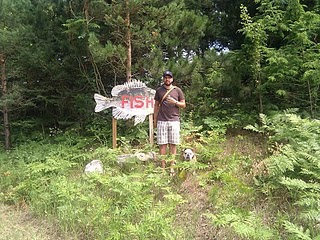
If you like seafood, search for the fish-shaped sign on South Lakeshore Drive. From the Oceana Drive exit off US 31 in Pentwater, turn right on Lakeshore Drive and follow the winding lakeside road toward Ludington. Drive past the vacation cabins and beach mansions. When the road comes around a final wooded curve—just before the tree canopy lifts and the asphalt flattens—there, across from a bluff overlooking Lake Michigan, is the sign. It reads simply, "Fish."

Thirty yards north of the sign you'll find Bortell’s Fisheries, a square cinder block building that’s home to some of west Michigan’s best seafood. Bortell’s has been in business for six generations, since 1898 when Uriah Bortell first put fish to fryer. Six generations of Germans later, the Bortell family continues to run a tidy, utilitarian ship.

The outside of the building is brightly painted in a modern fish décor, but the inside retains the old-world, rustic feel you might expect from a rural fishmonger. The room is crowded by a glass cooler that takes up half the space. Behind the cooler, a deep fryer and a bare-bones menu on the wall. To the left is a small glass refrigerator for pop, and on the front wall, wood slat paneling adorned with historic photos of the building and its family.

Fish are available fresh or prepared, à la carte or dinners with French fries and coleslaw. Menu items include walleye, whitefish, and a variety of local and imported seafood. I recommend the perch dinner for $13.60: half pound of lake perch, half pound of fries, and a half cup of slaw, plus a Vernors ginger ale for good measure. The perch is some of the finest I’ve ever tasted—lightly breaded and übber fresh. Forget tartar sauce, forget lemon, forget salt; the fish is it—crisp on the outside, buttery and flaky on the inside.

Two dining options: To-go, or at outdoor picnic tables. For cooked food, the tables work just fine, and even in rain they’re covered with sizeable umbrellas. For hours of operation, an approximation of lunch to dusk seems about right. Open through Labor Day. 5528 S. Lakeshore Dr., Ludington, Michigan, 231-843-3337. *A version of this post originally appeared on Tim's blog, Great Lakes Guru, on July 13, 2010.

Tim Chilcote is a writer, editor, teacher, and Michigan enthusiast. Though he lives with his wife and bulldog in Ann Arbor, he is a Muskegon native and frequent visitor to Michigan's more western climes. You can often find him standing near signs and billboards fashioned to resemble his favorite state's tastiest native species.

Monday, August 1, 2011

Taking food from the wild - a reframing of everyday food values

By Weston Eaton

A version of the following post appeared in Recoil Magazine.

I come from a family of trout fishing enthusiasts, not uncommon in Michigan, a state blessed with small, cool streams and an abundance of trout. So for much of my life, packing a cold truck with fishing tackle and lunch coolers in the dark hours before dawn has been a right of Spring. The big day is the last Saturday of April, official season opener, and many of these Saturdays entailed me and my brother riding north with my father to meet his father and brother on a dark, forested two-track somewhere near Paris, MI. Invariably, the mornings were cold. With frozen fingers, we’d thread our hooks in the headlights and make our way over barbed-wire fence rows towards the sound of rushing water, eager to stalk a Brown or a Brookie. With frozen eyelets we’d fish until hunger brought us back to the truck to eat lunch--pickled bologna, cheese sandwiches and venison jerky--exchange fish stories and later look for Morel mushrooms in the afternoon heat. In the evenings we’d clean our catch and feast on the day’s successes. Without realizing it, our days spent out-of-doors, waist deep in streams were as much about enjoying food and finding food as they were about the sport of catching fish.

Over the years I’ve continued to hunt Morels and walk river banks in search of trout, but mostly on streams new to me as our old family haunts have slowly been purchased by new landowners and posted with no-trespassing signs. This Spring, however, after a long absence, my father and I decided to again make our dark voyage to the old stream, hide the truck and head back into the now overgrown brush. As I worked my way downstream to my favorite old spots, keeping my profile below the high clay bank as to not signal the dog at the new neighbor’s camp, I thought about the simple fact that I was out looking for food--wild food, foraged food, food from the woods. In my mind I saw a clear path from the fish in the dark, swirling water under the roots of the cedar tree on the far bank to my cast iron skillet and dinner plate. My stomach growled a little, reminding me of the task at hand, so I added a sinker to keep my crawler under the rapids and worked my line steadily across the gravel bottom towards my hoped for dinner.

Good thing there are other dinner options, because trout can be elusive. The relationship between hunting and eating may sound obvious, but the point of my story here is to show a deliberate, although fleeting connection between the two. Whether bent over, wandering across the forest floor in search of Morels or waist deep in a gushing stream, the purpose of the excursion is to find food--an essential human act. There are of course other reasons to take to the woods in search of game--the thrill of the hunt, the tug on the line, the glimpse of a shriveled, leaf shrouded cap--but ultimately these indicators lead to dinner. When they don’t, trophy hunting results, a sign the fetish of the hunt has eclipsed its greater purpose.

By putting hunting and gathering back together with eating, we can get a glimpse at how far the act of procuring food has become detached from our everyday identities. Fishing, hunting and foraging can lead to a deeper kind of eating experience, one wrought with memory, experience, a sense of place and a story. The food most of us eat on a daily basis also has a story, one shrouded in commerce, technology, and advertising. Most of the time we are not able to decipher where our food comes from and are left relying on the opinions of experts--a confusing prospect since food and nutrition expertise is biased with the values of food scientists but at the same time necessary for making decisions about what and how to eat. Such is the fate of a modern life, one that often leaves us with a nagging sense of uncertainty and inauthenticity. Eating and drinking at the beginning of a food or beverage’s life may prove to be a remedy against this culinary malaise. Like imbibing a glass of homemade wine or a pint of home-brewed ale, a meal taken from the woods, at the expense of your own time and handiwork, can cut through the alienating machinery of the industrial food production system. An old friend of mine used to say gathering wild food from the woods and fields was one of the few remaining ways to fulfill your basic needs outside of the capitalist system. Finding your own food can then be seen as a political act, not to mention spiritual quest. Not bad for a day spent having fun in the woods.

Foraging and eating game you yourself caught is not practical for everyone, doing so is at the extreme end of fulfilling the basic and not-so-basic needs of a living person. But move a little closer to center and you still find a whole range of options before you come to processed foods, options such as locally grown, seasonal and fresh fruits, meats, dairy products and vegetables with histories a little easier to trace. The other extreme is then exposed: the profitable and corporately controlled world of industrial food where the needs of the eater - spiritual, nutritional or otherwise - are conspicuously absent. Thinking in these terms helps us reframe industrial food from mainstream to outlier. When juxtaposed with industrial food, picking mushrooms and taking wild game is a small act of food revolt.

From this we can glean some philosophical insight into industrial food. For starters we might first recognize that it is not necessarily the only or best option for feeding ourselves. As more and more people express increased interests in food pathways, food sources, agriculture and eating in general, its useful to reconsider our hunter-gatherer roots; from there we can perhaps best learn to appreciate the extreme challenges and triumphs once associated with the now everyday task of grocery shopping, cooking and eating. Not that fishing and rooting for Spring fungus can supplement more than a few meals a year, but collecting food from the wild can help forge a connection between ourselves and our ancestral past--a time characterized by a dependency on nature as opposed to an attempt to master it. The idea or action of bringing food out of the wild may just be a way to strike a balance between these two extremes.


Former Siciliano's staffer Weston Eaton is currently pursuing a PhD in Sociology at Michigan State University. He lives with his wife and dogs in Grand Rapids, MI, where the food, like most Buzz contributors, are as wild as it gets.