View our Main Site »
Showing posts with label Wes Eaton. Show all posts

Tuesday, November 5, 2013

Revisiting Home Winemaking

By Weston Eaton

Perhaps I best begin this essay by noting what it is not about. Rather than providing detailed instructions on how to make wine from grapes or from a winemaking ingredient kit, I want to instead tell the story of my own home winemaking experience. For explicit instructions on making wine, visit Siciliano's Market or their website. What follows here is a description of what it takes to make wine at home, which I present as a primer for those interested in taking up the practice of winemaking, as well as to those of you who have wondered what I am up to out in my garage.

Although increasingly popular and visible, home winemaking is nothing new. Like all fermented products, making wine is essentially a means to preserve produce, in this case grapes or other fruit. All wine, of course, was once “made at home.” In particular, up until the industrial and scientific revolutions of the sixteenth and seventeenth centuries, home beer and winemaking in (Europe at least) was the providence of women working at home. However, along with the rise of science and technology came an increased division of labor between men and women, resulting in the masculinization and professionalization of beer brewing and wine making. While farmers and others continued to make wine from their own grapes, these historic processes were largely successful is separating lay people—me and you—from professionals. As a result, wine was something that was bought, rather than made for one’s self or family.

Steve Siciliano (left) and Wes Eaton
crushing grapes behind Siciliano's Market
In North America, the lay/professional divide was challenged by early homebrewing pioneers such as Charlie Papazian, whose “off-the-grid” ethic personified a movement bent on taking fermentation out of the hands of professionals, whose products were getting stale frankly, and redefining what fermented products could and should be. From my perspective, the home beer making movement is key for home winemaking. However, there are distinct histories, which are likely due to necessary ingredients. Unlike beer, which requires malted barley, hops, and brewers yeast—items not normally grown in the yard—wine can be made from anything (although some ingredients, such as grapes or apples, are likely to produce superior wine than others, such as onions). Due to the accessibility of ingredients, home winemaking remained a practice passed down generation to generation, taking place in cellars, garages, and barns.

"I'm crushed," said the little grapes.
The distinction between beer and winemaking first became apparent to me while working at Siciliano’s Market. Whereas homebrewers were often younger folks generally new to fermentation, and were either in search of a new hobby or fascinated by craft beer and looking for a way to create their own, winemakers were often confident in their general understanding of the practice—they had seen their uncle, father, or grandfather make wine in the cellar or barn years before. When they did have questions, the trick was to introduce some of the ‘science‘ of wine-making–sanitization, yeast, sulfites, pH, gravity, and so on—in ways they were comfortable with and that enhanced, rather than intruded upon, their vision for what winemaking was. Others, including myself, were introduced to winemaking as an extension of the repertoire of possible fermentation activities, including cheese and yogurt making, beer, and pickles. Grapes, however, were not alway available. In this way, I came to understand wine making as a seasonal activity, like maple syrup making, in that one makes wine when the grapes are ready.

Seasonality then is my first point in explaining my winemaking practice to inquiring minds. I use fresh grapes, grown near Allegan, Michigan, by Taylor Ridge Vineyards, although there are numerous vineyards one can order winemaking grapes from. Depending on the year, as well as variety, grapes are generally ready for harvest from late September until late October, which means you must be ready for them. Once picked, it's best to process your fruit within 24 hours, lest the fruit flies and elements dampen their quality. Most home winemakers think in terms of 6 gallon batches, which makes thirty 750ml bottles. A batch generally requires one hundred pounds of grapes.

Bryan Taylor of Taylor Ridge Vineyards
Processing your fruit is my second point. Again, the folks at Siciliano's can provide you specifics; my intent instead is to paint a clear picture of what it takes to make wine. First, your grapes need to be crushed and de-stemmed. One can indeed do this by hand, depending on the volume! Or one can use equipment meant for this, such as that offered for rent on site at Siciliano’s Market. [Editor's note: Contact Siciliano's for more information on renting our crushing/destemming equipment.]

Second, red grapes will ferment on the skins, in a large crock, plastic or stainless fermenter, whereas whites will have the juice pressed off immediately. Fermenting on the skins allows for the extraction of tannins and colors into the must, which is the fermenting liquid slurry. Once fermentation is complete, in about a week, the skins are scooped into a wine press and the juice is collected into a glass fermenter. Once sediment collects on the bottom, the wine is then transferred to a final fermenter, where oak is added, and the wine ages 'in bulk.' In fact, I set my wine aside, on oak, until the following year’s grapes are ready, and bottle only when I am getting next year’s vintage started.

With even this brief description, one can see that winemaking, for me at least, is a process that takes place over the course of the year, and that becomes ingrained in the seasons and in this way built up over time as a family tradition. I’m sure there are other ways to do this, ways that are suited to the constraints of other households and families. But this is precisely the point I would like to emphasize: Winemaking is a rich practice that takes place over the course of months, albeit in numerous short spurts of activity. Its rewards are both immediate—the satisfaction of transforming grapes into must, and activating fermentation for instance—as well as long term. This holiday season, for instance, my family will be enjoying my 2010 vintages.

Monday, April 29, 2013

Craft Beer Culture in Michigan

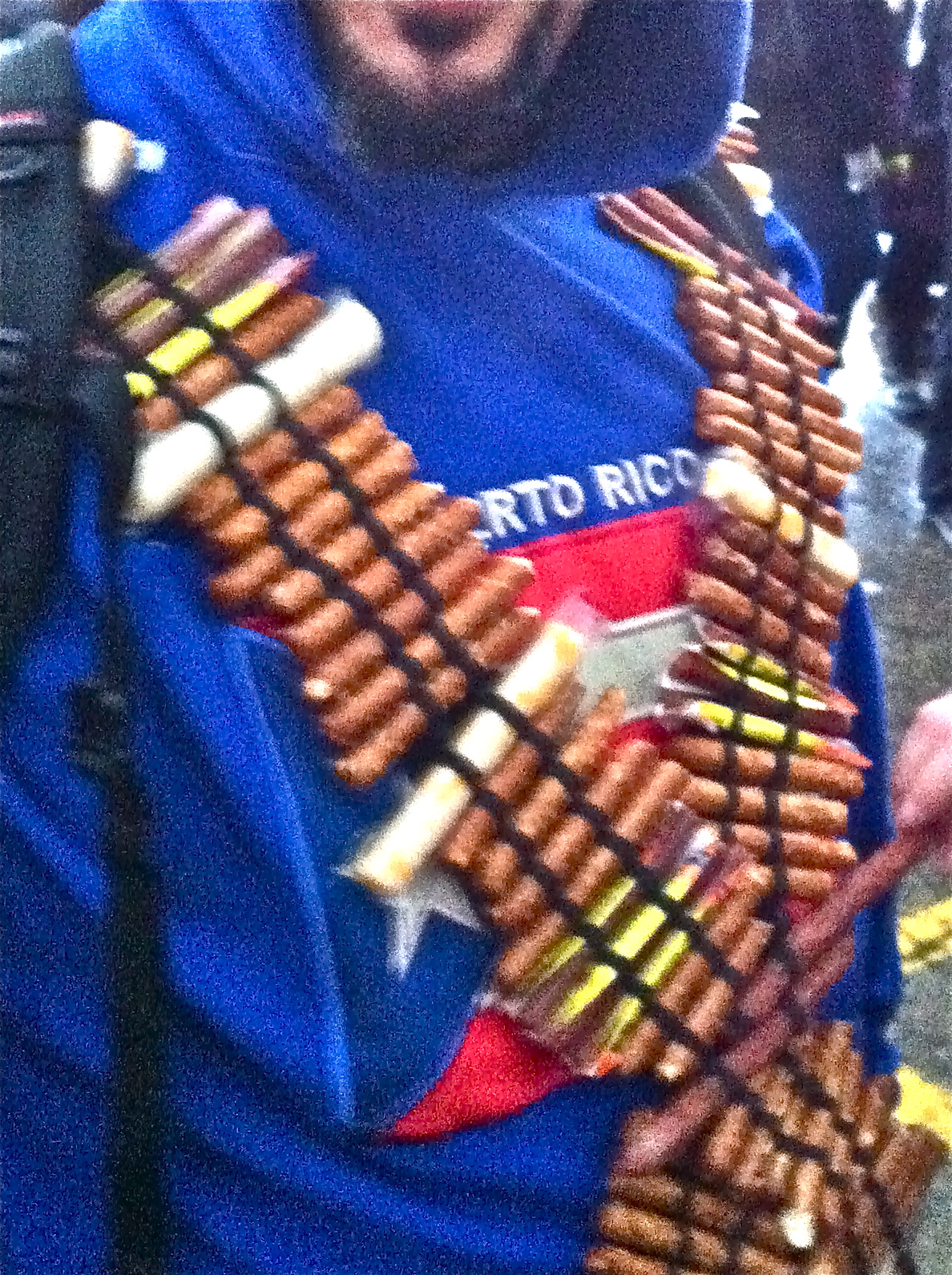
The craft beer culture is thriving in Michigan. But how exactly is that culture defined? Among other things, with pretzel necklaces.

Pretzel bandolier
By Wes Eaton

We often hear allusions to “beer culture,” but what exactly does this mean and why is this important? We all know what beer is: fermented malt beverage. But of course, to different people in many different ways, beer is so much more. In West Michigan, beer is increasingly important to the broader do-it-yourself as well as economic growth agendas, which contributes to heightened visibility through media coverage as well as everyday discussions. We are often asked, ‘have you been to the new brewery?’ to which we now reply, ‘which one?’

The Michigan Brewers Guild Winter Beer Fest is big discussion not just for beer geeks but for everyday people who increasingly find craft beer to provide opportunities for community, livelihoods, and a good time. Here is the link to culture that I want to explore. If beer is more than malt beverage, how can the concept of ‘culture’ help us understand its importance and increasing prominence in everyday life? To answer this, I’ll first discuss why culture is important and provide two ways culture has been conceptualized. I’ll then provide some examples from this past winter’s Winter Beer Festival to illustrate the importance and power of culture.

Why is culture important and what does it mean to say culture is “powerful”? Essentially, culture is important as it provides a way for us to make a link between the realms of symbols/meaning-making and social action. In other words, culture is powerful as it is the bridge between ideas and the things we do. How does this bridge work?

Cultural theorist Ann Swidler tells us that there are two dominant ways people think about the concept of culture. The first she calls culture from the “inside out” in reference to what is imagined to be going on inside people’s heads. In this model, people are constrained by the ideas they find out there in the world. Swidler tells us that, from this perspective, “culture shapes action by defining what people want and how they imagine they can get it.” This perspective comes from the famous social theorist Max Weber who tells us world views and ideas are the “switchmen” on train tracks that determine which paths we will take in life. Swidler argues that this perspective is not very helpful as clearly we do not know what is going on in people’s minds.


Swidler labels the second perspective culture from the “outside in,” which argues culture should not be studied as something that is only inside people’s heads. Rather, culture can be thought of as “publicly available symbols—rituals, aesthetic objects,” and other physical manifestations. From this perspective, culture is not useful for explaining individual actions or ideas, values, dogmas, or other meanings, but instead represents the “symbolic vocabularies, expressive symbols, and emotional repertoire” of everyday life. The essential point Swidler tells us is that culture is not the ends that people seek, but the tools people use to seek out anything that they wish. In other words, culture is a “tool kit” of habits, skills, and styles that people use to construct their strategies of action in life. By thinking about culture as a tool kit, we can better investigate shared collective and public meanings and symbols and how these are meaningful to people.

Let’s give this a try by looking at examples from this past winter’s Michigan Brewers Guild Winter Beer Festival held in Grand Rapids. The event is a spectacular menagerie of experimental beers and experimental people. Culture is on display, from the way brewers and breweries present themselves and their beers to the hats, outfits, and especially pretzel and other edible necklaces of the beer culture elites. Short’s brewery, for instance, is consistently a crowd favorite not only for their beer but for their outrageous, inventive, and provocative displays of beer culture. In years past, Short’s crew built their serving booth from blocks of ice cut from a northern Michigan lake and added marshmallows that were toasted with a handheld torch on site to their S’more Stout. Such acts are deemed provocative as they violate the boundaries purists envision for what constitutes “true” beer, much in the same way that the Campaign for Real Ale (CAMRA) works to “differentiate between the bland processed beers being pushed by the big brewers and the traditional beers whose very existence was under threat.”

For me, the most striking and powerful example of beer culture, however, is the pretzel necklace, or at least what started as a pretzel necklace and has now grown to include snacks not usually strewn around one’s neck. As you can see from the photos, cheese sticks, meats sticks, popcorn, and even chicken legs were not off limits for innovative beer fans. What is important here is the power these necklaces afford their wearers. Much in the same vein as a tribal warrior with a rope of bear or tiger teeth around their neck, the beer fans whose necks are weighted down with meats and sweets are respected and even feared in the sense that they are displaying their experience and intensity. These are fans to be reckoned with. Clearly one who took the time or had the foresight to construct such a badge of courage and tenacity knows why they are there and that they belong. Moreover, seeing such powerful symbolic displays leads one to ask ‘do I belong here? These people are the real thing!’

To pull this all together then, I suggest that we think about beer culture as the collective and symbolic expressions of a group or collective identity. Beer culture is something we display, and the importance of that display is only ever meaningful within this group. Wearing a pretzel necklace in the classroom or the office, for instance, is less likely to imbue one with power as it is to incite suspicion and mild anxiety. Moreover, beer culture does not move us around like pieces on a chess board, it does not determine or even guide the actions of people. Instead, we draw on the shared elements of beer culture—e.g. our knowledge of styles or the history of India Pale Ales, the difference between a stout and a porter, number of batches brewed, the Imperial Stouts or out-of-state beers in our cellar, number of MI beers on tap, being rated as “Beer City USA” and so on—like tools in a tool kit to accomplish what it is we hope to do. And in the realm of craft beer, this often has to do with building a specific collective identity that is opposed to the main mainstream elements of both beer brewing and life in general.


Monday, October 29, 2012

A Good Night on Grand Rapids’ West Side

IMG_3455

This piece was written the morning after Game Two of the 2012 Word Series. Despite the Tigers' difficult loss in that game (and in the Series in general), former Siciliano's staffer Wes Eaton managed to find the beauty in a West Side Thursday night.

By Weston Eaton

While there are many that can speak with more authority on the matter, I’m certainly not a slouch when it comes to Grand Rapids’ West Side. Between small bowling allies, butcher shops, Latino grocers, Monarch’s Club, and Siciliano’s Market, I cross the river on at least a weekly basis. Max Trierweiler and Chris Andrus now bring us all one more reason to do so: the Mitten Brewing Company. As I’m sure many of you have heard, the idea is to bring together craft beer and baseball in an explicit way – hence the name “mitten”.

With the Tigers in World Series crises mode, my wife and I headed to the new “sports” bar, snuck in the back door to avoid the half block long IPO (initial public opening) line out front, and made our way to the bar in much the same way one struggles to front stage at the Orbit Room. While the room was packed and lines long, this is to be expected on an opening night. Or is it? With restaurants and craft breweries popping up like Morels in Spring across West Michigan, you might think that new craft beer venues like Perrin, White Flame, Harmony, or the Mitten (to name just a few) would need to slowly, steadily cultivate a dedicated following, and that this would take time. Indeed in the long run this may be the case, but from my recent experiences in the taproom at Perrin and last night at the Mitten, I got the feeling the beer was going to stay fresh.

Speaking of beer, my wife wrestled us a Porter and Hefeweizen from the throngs. Both were excellent, the Hefe closer to a Dunkel Weizen, the color of hazelnuts, and the Porter black with a tiny tan head and a heavy roast, which is how I like it. Not exactly sure who brewed these beers, but its likely the Mitten’s new co-brewer Robert Wanhatalo (aka Wob), formerly of the Hideout, played an important part. In the future, look for experimentation in line with the trails blazed by Joe Short.

While drinking our inaugural beers, we looked over the beer and baseball fans, finding more than one Beer City USA t-shirts on display. Like other badges, this symbol has come to embody a new collective identity within the area’s beer community, a signifier of not only past and present successes, but also a suggestion for future agendas. I felt this momentum, this change, strongly when walking past the the old firehouse that is the new brewery. I knew where I was – the city’s West Side, across from the seasonal Latino ice cream stand, the old Juke’s bar, and Quarry Ave, where I lived for years and my wife grew up – but now these familiar places seemed much more a part of the past, and the street lined with beer (and Tigers) fans was something new. I am not lamenting change now, and this is not what I experienced last night. Instead, I felt a little ‘Brooklyn’ in the air, meaning to say a buzz of activity and possibility that excites and inspires.

But this is of course only one way to understand the city’s West Side, on the cusp or not. In fact, telling the story in this way downplays culinary and beer culture happenings that have been going on in the areas for some time now. Moreover, I’ve clearly defined “the cusp” by my own biased set of standards – through the lens of craft beer. There are of course other ways to value the West Side, in terms of beer culture. Take for instance the Holiday Bar, a special treat a stone’s throw away from Salvatore’s Italian Restaurant (which serves the best lasagna in town).

Stepping out from the Mitten’s IPO energy, we were still thirsty and the game was still on – and the Holiday was waiting. Were were greeted with numerous seats at the expansive, curved, lounge style bar, and the enthusiastic Jim, Grand Rapids’ most ubiquitous bartender. Yes there are craft beers on tap – some of the city’s finest – but the circumstances, meaning a need for some perspective, called for tasty cheap red wine and a cold High Life. Developing an appreciation for this range, from the new to the old, is what the coming West Side experience is all about.

Monday, August 29, 2011

Plant garlic now, thank yourself next year

Oh the possibilites
By Wes Eaton

The time has come to plant garlic. Don’t waste your time planting cloves you buy at the grocery store, however--according to Rodale’s Encyclopedia of Organic Gardening, these may have been sprayed with an anti-sprouting chemical. Instead, buy a few extra of those precious heads the next time you’re at the Fulton Street Farmers Market. But beware! Just because it’s on a farm stand does not mean it was grown in Michigan. Not to say non-Michigan produce is bad in itself, it’s just that, in this case, you definitely want to buy the local kind. Local garlic is of the "hardneck" variety. Also known as seedstem, it's different from the tepid, "softneck" garlic we have been eating most of our lives. Why should you care? Softneck garlic comes from Chile or California, and while there might be some good-sized cloves in the head, there are also too many smaller ones, which are pesky to peel and basically filler. Though hardnecks can be more difficult to grow, they taste better and the clove size is more uniform.

Not so long ago I felt what many of you must be feeling right now. My friends would tell me about hardneck garlic and I’d complain about the price, availability and overall elitism of preferring one garlic variety to another. I was content peeling ever-smaller Californian or Chilean cloves. If I got irritated, I’d just pour another glass of wine. Things changed when I finally took some local garlic home and witnessed the difference for myself: full, off-white, robin-egg-sized cloves, pungent fresh juices concentrated homogeneously throughout the moist and snappy lobe. The outer skin was white and beneath it the hues turned purple then white again where the root was bared. Already I had feelings for this garlic like I’ve never had for any member of the onion family. I chopped softly, finely, gently sautéed in yellow, fatty butter and spread on a fresh warm, crusty baguette. No woody, stem like flavors. No acidic overtones. No spongy chew near my molars. Just a baked-Macintosh-apple-like consistency with a rich, heated acidic sugar flavor. I hid the remaining cloves in the crock and out-of-sight.

Garlic, it plays well with others

I went back to the farmers market to tell the farmer how good his garlic was. His tight-lipped smile and precise nod signaled to me that we had an understanding. The garlic spoke for itself; he need not explain. Just then an older Italian woman asked the price for a gorgeous bunch hanging between us. She was not going to pay $15 for a dozen heads, forget the culinary ecstasy that awaited her. Good news for me because the garlic supply runs low about this time of year, precisely when you wish you had a few extra heads to roast while you’re planting a couple of rows beside the garage.

According to my sources, now is the time to plant. Prepare your soil--get rid of weeds, loosen up the top few inches and mix in some compost (four dollars for 50 pounds of organic from Lubbers Family Farm). Plant in full sun, about an inch or two deep with the root end down, keeping cloves three to a foot and rows at least a foot apart. Cover with dried grass or other mulch. Getting them in the ground now will give them time to develop a root, keeping them in place during the freeze. When the snow tapers off and the maple sap begins to run, look for the first shoots. Eventually these will curl over into scapes, a delicate, seasonal morsel. Snip them off and eat to encourage bulb growth. Harvest when you begin to see new garlic on the tables at the farmers market.

By the way, there are several health benefits to eating garlic raw. It lowers cholesterol, warms the body, improves circulation, and has fungicidal and antimicrobial properties. Eating fruit or fresh parsley afterward will mitigate (what some consider) the "offensive" aromatic effects. 

The editors suggest saving a large portion of the garlic harvest for use in many loaves of roasted garlic no-knead bread. For the recipe, click here!


Former Siciliano's staffer Weston Eaton is currently pursuing a PhD in Sociology at Michigan State University. He lives with his wife and dogs in Grand Rapids, MI, where it's only a matter of time before someone invents a garlic-flavored beer.  

Tuesday, August 23, 2011

Making salsa from the garden

By Wes Eaton

I just made three quarts of scrumptious fresh salsa and before I even begin cleaning up the kitchen, I want to share my recipes, reasonings and experience with you all. What made it so good? There’s many ways to answer that question, but of course a reasonable explanation would take into account the ingredients.

Enter the tomato. Few vegetables equally capture the passion and obsession of gardeners. Just awhile earlier, before the sun set, I was harvesting from my backyard raised-beds and holding up a fat Brandywine, irregularly lobed, deep fissures with an animated belly-button on the blossom end, hefting its girth with surprise and satisfaction, recognizing the absolute handiness of its being, and looking around, half expecting someone to holler, “Hey! That’s a handsome tomato!” I put this in my basket and added a couple dozen Rome and Roma, a handful of jalapenos, habanero and wax peppers and some cilantro, went to the garage to clip some garlic from the drying rack, and then to the cellar for white onions, apple and red wine vinegar. Add a little salt and lime from the kitchen and I had all the makings for a fresh salsa.

As I didn’t have a particular recipe in mind I went to my essential sources. First I looked up Tomatoes in Harold McGee’s indelible On Food and Cooking: The Science and Lore of the Kitchen. McGee lets us know tomatoes are actually fruits we use as vegetables. He links their popularity to their unique flavor, due to their unusually large amount of glutamic acid and sulfur compounds--food components more often found in meat, and thereby highly complementary to hearty dishes such as rich salsa.

Next I looked to Madison CSA coalition’s From Asparagus to Zucchini, the guidebook on storing and using fresh vegetables to find that tomatoes, originally from the warm climates of South America but later domesticated in Mexico, are best stored warm as opposed to in the fridge. Additionally, tomatoes continue to ripen once picked, advisably done out of the sun.

Finally I dug out Bollin’s Salsa Lovers Cookbook, a Southwest-published, spiral-bound treasure with hundreds of recipes as well as techniques for blanching tomatoes as well as preparing and storing chiles. Bollin tells us chile (not chili) is the common name for hot peppers, such as Anaheim, jalapeno and serrano commonly used in Southwestern and Mexican cooking. Additionally I noticed two trends and therefore decided on two different recipes, one using tomatoes and chiles with skins removed through blanching and roasting, respectively, and the other with untampered ingredients.

According to Bollin as well as Madison CSA’s volume, blanching is simple: dunk whole tomatoes in boiling water for 15-30 seconds, lift out with slotted spoon, and remove skins. Before doing so, I shallowly cored my Romes, cut a slight “X” on the blossom end and finished the fruits in a bowl of ice water. The skins actually fell off by themselves. Roasting chile peppers, however, was a bit more challenging. The goal is to heat “the chile to enable the tough transparent skin to separate from the pod so that the skin can be removed”. So while I grasped the chiles with tongs and roasted them over fire until blistered, and rested them in a plastic bag for ten minutes, I still needed finally to scrape the skin from the pod with a butchers knife. Eventually preparations were done and it was time to put things together. After consulting these and other sources, including a friend well known for his cutting edge salsa, I settled on these two recipes I’m calling Traditional and Garden Salsa. They represent inspiration from all three sources above.

Wes’ Traditional Salsa (for one quart) 

    • 8 large, ripe Rome, Roma or other ‘paste’ variety tomatoes that have been blanched
    • 6 roasted, skinned and seeded chiles (I used two each of Anaheim, jalapeno and cayennes)
    • 1/4 bunch of cilantro
    • 1 medium white onion
    • Juice from 1/2 lime
    • Splash of both red wine vinegar and apple cider vinegar
    • Salt to taste 
Wes’ Garden Salsa (for two quarts) 

    • 12 large, ripe Rome, Roma or other ‘paste’ variety tomatoes
    • 4 large wax peppers
    • 1 habanero
    • 5 cloves garlic (preferably hard-neck)
    • 1/2 bunch of cilantro
    • 1 medium white onion
    • 1 medium red onion
    • 2 splashes of both red wine vinegar and apple cider vinegar
    • Salt to taste 
Actually making the salsa is a simple affair. Add all ingredients minus the tomatoes to the blender and quickly blend. Once things have begun to chop up, add the juicy tomatoes and blend just a moment longer. While tomatoes are naturally high in acid (low pH), the vinegars and salt help further preserve the salsa you don’t finish tonight for days in jars in your fridge.


Former Siciliano's staffer Weston Eaton is currently pursuing a PhD in Sociology at Michigan State University. He lives with his wife and dogs in Grand Rapids, MI, where tomato, or not tomato--that is the question.  

Monday, August 22, 2011

Recipe: The mighty bread & butter pickle

By Wes Eaton

The bread & butter pickle is a tangy, crisp fall favorite, yellow from turmeric, with a nuanced tang from vinegar and mustard seed. Cured in the jar, these sandwich toppers will add a touch of rustic homeyness to your usual fare. I’m putting up a double batch right now and encourage you all to do the same. Keep reading to learn how!


Here's a list of things you'll need:

    • Canning supplies (canning jars, bands, lids, canner)
    • 4-6 pounds pickling cucumbers
    • 2 pounds medium white onions
    • 1/3 cup canning salt
    • 2 cups sugar
    • 2 tablespoons mustard seed
    • 2 teaspoons Tumeric
    • 2 teaspoons celery seed
    • 1 teaspoon peppercorns
    • 3 cups vinegar
    • 1 bag ice 
Start by planting a garden. Okay, a little late now, so start at the farmers market, or even the grocery store’s produce section. We're at the tail end of August, so fresh pickles will only be around a few more weeks. Ask for and choose firm, dark green, ‘box’ shaped pickles, no longer than six inches. Slice chips to a width of less than a quarter inch with a serrated tomato knife for authentic ridging. Peel and slice the onions thin and mix all together in a large bowl with canning salt. Cover the veggies with ice. This quick cold brine extracts excess water from the pickle chips and contributes to lasting firmness and crunch. Place in the fridge for an hour at least and then drain and rinse.

Driving out excess water with salt

Meanwhile, wash your canning jars in hot sudsy water while bringing your canner bath to a subtle boil. As the time nears, place remaining ingredients in another large pot and bring to a boil. Add the rinsed pickle chips and onions and return to a boil. With everything heated up, its time to carefully pack your jars, wipe the lips, screw on the lids and process in the boiling canning bath for ten minutes.

A medley of flavors

Let your jars cool somewhere away from cool late summer breezes. Patiently listen for the lids to pop in, indicating a good seal; it may happen quick, but could take an hour or so. Those that don’t seal can be stored in the fridge. This should give you plenty of time to reflect on your efforts--good food you carefully prepared yourself, with ingredients of your own selecting and choosing. Satisfaction is what I’m talking about, with product to show for your efforts. Laying down preserved food, much like laying down wine or beer, affords you a sense of participation in the creation of your daily surroundings--the stuff that makes up your reality. An existential leap? I’ll leave that up to you. As for the flavor and snap, it's a no brainer for fans of the mighty bread and butter pickle.

Sealing the time capsules


Former Siciliano's staffer Weston Eaton is currently pursuing a PhD in Sociology at Michigan State University. He lives with his wife and dogs in Grand Rapids, MI, where pickles aren't his bread & butter, but bread & butter are among his favorite pickles.